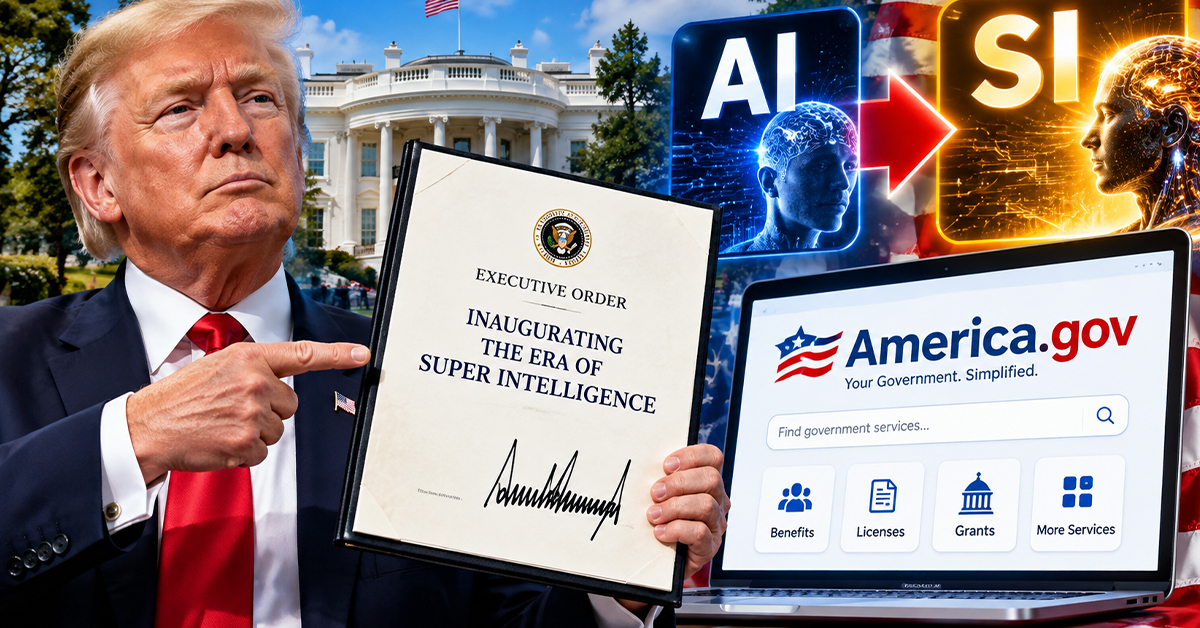

US President Donald Trump signed two executive orders on September 29, 2026, directing federal agencies to adopt the term “Super Intelligence” instead of “Artificial Intelligence” and establishing plans for a unified online portal for accessing federal government services.
The directives outline changes to federal technology terminology and a new approach to delivering digital government services.
Trump Directs Federal Agencies to Adopt ‘Super Intelligence’
In an executive order titled “Inaugurating the Era of Super Intelligence”, Trump directed executive departments and agencies to use “Super Intelligence” and “SI” in place of “Artificial Intelligence” and “AI” in official correspondence, public communications, websites, reports, policy documents and other non-statutory documents.
The order describes the terminology change as a reflection of the expanding capabilities of advanced intelligence technologies. It states that these systems increasingly amplify human ingenuity and enable new forms of creativity across scientific research, medicine and other fields.
The directive does not require federal agencies to revise previously issued regulations, presidential actions, contracts, grants or historical documents.
For the purposes of the executive order, the federal government will initially use the existing statutory definition of artificial intelligence under Section 9401(3) of Title 15 of the United States Code.
The order also instructs the Assistant to the President for Science and Technology to submit proposed legislative language establishing a federal definition of Super Intelligence within 60 days of the order’s date.
America.gov to Become a Unified Federal Services Portal
A second executive order, titled “Streamlining Access to Government Services Through America.gov”, directs the establishment of America.gov as a unified digital entry point for people seeking federal information and services.
According to the order, the portal is intended to provide a secure, conversational platform where users can sign in, communicate in plain language, receive answers and complete eligible government transactions when authorized and technically available.
The initiative aims to reduce the need for people to navigate multiple federal agency websites to access public services.
The order assigns responsibility for establishing and operating America.gov to the Administrator of General Services, working with the Administrator of the National Design Studio and the Director of the Office of Management and Budget.
It also directs federal agencies to integrate eligible services with the portal and use Login.gov for authentication.
Which Government Services Are Covered?
The executive order defines covered services as public-facing federal services that serve more than 100,000 users within a 12-month period and can be accessed or applied for online.
However, the initiative excludes tax filing services provided by the Internal Revenue Service, services provided by the Department of War and services provided by elements of the Intelligence Community.
Federal agencies must identify eligible services and integrate them with America.gov in a secure manner that protects personal information.
The order also establishes a 90-day deadline for the Office of Management and Budget to issue implementation guidance to federal agencies.
Importantly, America.gov is not intended to become the only way people can access federal services. The directive explicitly preserves existing access methods, including in-person visits, telephone services, mail and individual agency websites.
What the Two Executive Orders Establish
The two executive orders address separate aspects of federal technology policy.
The first establishes the administration’s preferred terminology for artificial intelligence in executive branch communications and directs the development of a proposed federal definition of Super Intelligence.
The second sets out a framework for consolidating access to eligible federal services through America.gov, including requirements for agency coordination, authentication and privacy protections.
Both directives establish responsibilities and implementation requirements rather than confirming that all proposed changes have already been completed.
Their practical effects will depend on subsequent agency actions, the development of the proposed federal definition and the implementation of the America.gov platform.