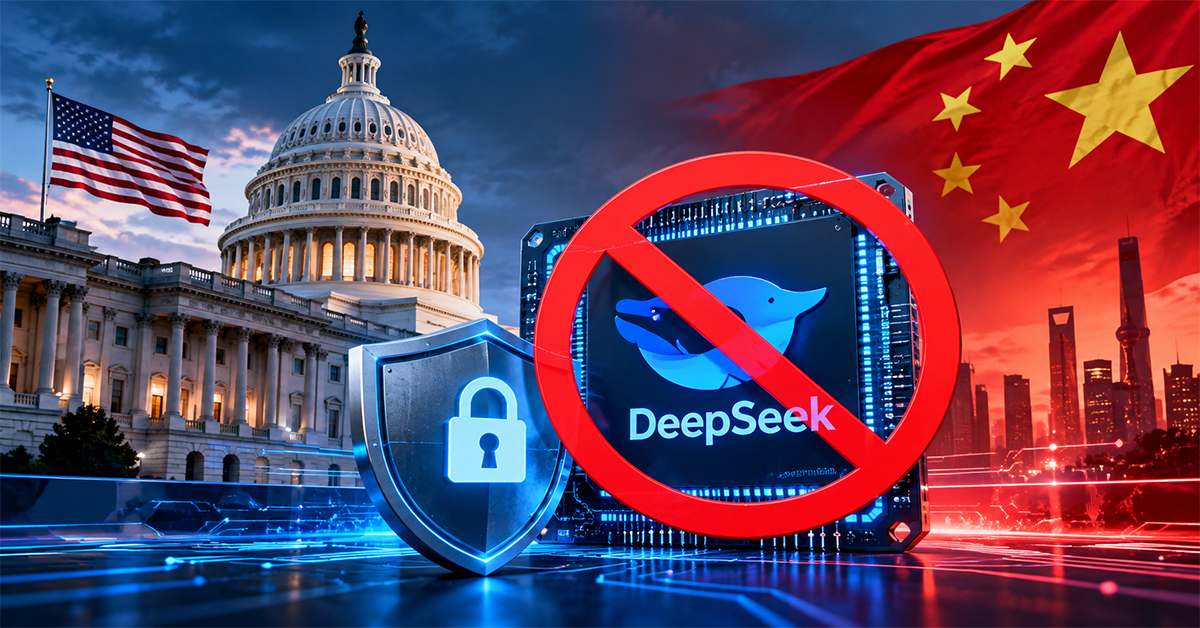
The United States has ordered federal civilian agencies to remove DeepSeek AI products from their information technology systems and stop procuring them, citing national security concerns. China has condemned the decision, escalating tensions over artificial intelligence (AI), data security and technology competition.
The order, issued by the Department of Homeland Security (DHS), covers DeepSeek products and certain third-party services built using its technology. Beijing argues that Washington is using national security as a justification to restrict Chinese technology companies.
What Does the US DeepSeek Ban Cover?
The DHS order was filed on October 19, 2026, and published in the Federal Register on October 20. Issued under the Federal Acquisition Supply Chain Security Act of 2018, it requires the exclusion of covered DeepSeek products and services from federal civilian agency procurement and their removal from civilian government IT systems. The official notice identifies the affected products and legal authority.
The restrictions extend beyond DeepSeek’s own applications to include affiliated products and third-party products or services developed using DeepSeek implementations.
| Area | What the order means |
|---|---|
| Federal civilian IT systems | Covered DeepSeek products must be removed |
| Government procurement | Agencies are prohibited from acquiring covered products and services |
| Third-party tools | Products built using DeepSeek implementations are included |
| Private businesses and individual users | The order does not establish a general US-wide ban on their use |
| Military and intelligence systems | These are outside the order’s stated civilian-agency scope |
Source: US Federal Register, October 20, 2026.
Why DHS Cited National Security Risks
DHS warned that using DeepSeek could expose sensitive government information to China. Its concerns include the location of DeepSeek’s servers in China and the potential for Chinese authorities to access information under applicable Chinese laws.
The department also described the models as presenting multiple security threat vectors. However, the public notice and reporting cited here do not establish that DeepSeek has stolen US government data or that a specific malware incident has been confirmed.
That distinction matters: the order is a government security decision based on identified risks, not proof that every suspected threat has occurred. DeepSeek had not responded to media requests for comment when AFP published its report on October 20. AFP’s coverage provides further context.
China Condemns the Move
China’s Foreign Ministry opposed the ban on October 20. Spokesperson Mao Ning criticized what Beijing considers an excessive expansion of national security arguments to suppress Chinese companies.
China’s Ministry of Commerce also expressed strong dissatisfaction and warned that Beijing would take measures to protect its interests, according to reporting by The Associated Press.
The dispute comes amid broader competition over AI capabilities. US officials have accused DeepSeek and other Chinese firms of improperly extracting capabilities from advanced American AI models. China has rejected such accusations. These claims should be distinguished from independently established findings about specific conduct.
Despite the tensions, the two countries agreed in September 2026 to establish a communication channel for AI-related incidents. Their leaders are expected to meet at an APEC summit in Shenzhen in November, where AI and technology policy may feature in discussions. The impact of the ban on those talks remains uncertain.
What Readers Should Know
- The ban is specific in scope: It targets covered DeepSeek products in federal civilian government systems and procurement, including qualifying third-party implementations.
- The practical issue is government data security: Agencies must account for potential exposure of sensitive information when selecting AI tools.
- The allegations have limits: DHS has raised security concerns, but the sources cited here do not establish a specific DeepSeek-related data theft incident or confirmed malware attack.
Conclusion
The DeepSeek order draws a clearer security boundary around AI used by US federal civilian agencies while adding strain to US-China technology relations. Its immediate legal scope is narrower than a nationwide consumer ban, and the distinction between potential risks and proven misconduct remains essential to understanding the decision.
Sources and Further Reading
- Notice of Order Regarding Exclusion and Removal of DeepSeek Products — US Government Publishing Office
- China opposes US ban on govt agencies from using DeepSeek — AFP, October 20, 2026
- China defends DeepSeek after US ban of its AI from government systems — Associated Press
- US banning Chinese AI DeepSeek from government agency IT systems — Reuters, October 19, 2026