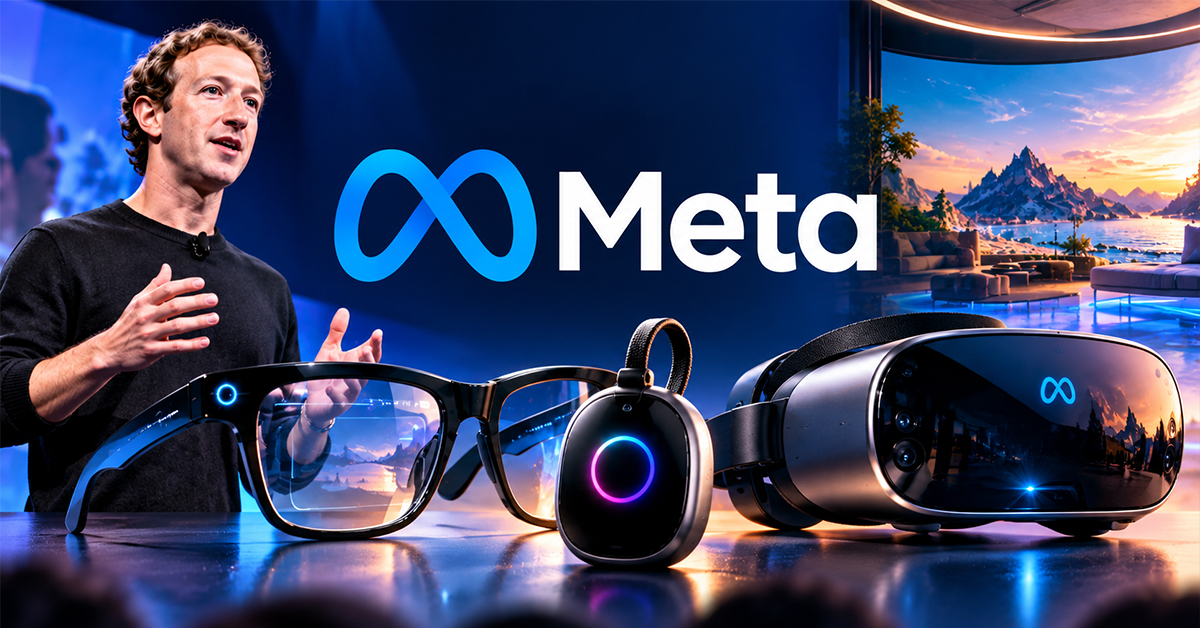

Meta is expanding its artificial intelligence strategy with a new generation of wearable devices and an upgraded personal AI assistant. At Meta Connect on September 23, 2026, the company announced Muse integration for AI glasses, introduced a pocket-sized gadget called Muse Charm, and revealed its new Meta VR Glasses.
The announcements show how Meta plans to connect AI software with devices people can use throughout the day. Rather than relying only on smartphones and social media apps, the company is developing hardware designed to make AI assistance more accessible.
But the new products also raise practical questions about privacy, reliability, pricing and whether consumers need additional devices alongside their smartphones.
1. Muse AI Moves Beyond the Smartphone
Meta is expanding Muse from a conversational assistant into a personal AI agent designed to help users complete tasks.
At Connect, Meta announced improved voice interactions, a real-time avatar experience and additional integrations with third-party services. The company also plans to bring Muse to its AI glasses, allowing people to interact with the assistant hands-free.
The glasses will be able to use visual information to answer questions about objects and surroundings. For example, a user could ask about a product on a store shelf without having to describe its appearance manually.
Meta also announced additional service integrations for shopping, travel and productivity. These include partnerships involving retail platforms, payment services and tools such as Notion, GitHub and Box.
However, integration does not mean unrestricted access. Individual services can determine what an AI agent is permitted to do, and some transactions may still require user confirmation.
For consumers, the important change is that AI could become a tool for completing specific tasks rather than simply answering questions. How consistently Muse performs those tasks in everyday situations remains to be demonstrated.
2. Muse Charm: A Small Device for Everyday AI

One of the more distinctive announcements was Muse Charm, a pocket-sized device designed to make the Muse assistant accessible without requiring users to wear smart glasses.
The gadget is intended to provide quick access to Muse’s conversational and avatar features. Meta introduced it as a separate way to interact with the assistant, particularly for people who do not want to wear camera-equipped glasses.
The concept addresses a real usability issue. Some consumers may prefer a small accessory over wearing technology on their face, especially in social or professional settings.
Muse Charm could also provide a more direct way to interact with an AI assistant while away from a smartphone. However, its usefulness will depend on the final hardware, connectivity, battery performance and supported functions.
Meta has not yet published a complete specification sheet or confirmed final pricing. The company has indicated that more information will follow, with the device being prepared for a holiday-season release.
Until those details are available, it is too early to determine whether Muse Charm offers enough advantages over existing smartphone AI applications to justify buying another device.
3. Meta Expands Its AI Glasses Lineup

Meta is also extending its AI glasses range through its partnerships with Ray-Ban and Oakley, while introducing its first audio-only glasses.
The new Ray-Ban Meta Audio glasses combine open-ear audio with AI features in a conventional glasses design. Open-ear audio allows users to hear sound without placing earbuds inside their ears.
Meta says the expanded lineup will include more than 100 styles across Ray-Ban, Oakley and Meta Glasses by the end of 2026. The Ray-Ban Meta Gen 3 range also introduces updated designs, controls and battery improvements.
The broader lineup gives consumers more choice in appearance and functionality. People who want audio and AI features without a camera may find audio glasses more suitable than traditional camera-equipped smart glasses.
Nevertheless, wearable AI comes with privacy responsibilities. Camera and microphone functions can affect people nearby, not just the device owner. Clear recording indicators, user consent and transparent data handling remain important considerations.
Availability also varies by market. Meta has announced new international markets for its glasses, but the timing of individual AI features and products is not necessarily the same in every country.
4. Meta VR Glasses Bring Spatial Computing to a Lighter Design
Meta VR Glasses represent the company’s continued investment in immersive computing.
According to Meta, the device weighs approximately 100 grams and uses a 5K Infinite Display based on micro-OLED panels. The company plans to launch the headset in spring 2027 at a starting price of $1,299.99 in the United States.
The design separates the head-worn display from processing and battery components housed in a separate pack. This approach reduces the weight carried on the user’s head, although it introduces the need to carry and connect another component.
The headset is intended for immersive entertainment, virtual workspaces and spatial computing. Spatial computing places digital content within a user’s surrounding environment, allowing virtual screens and interactive elements to appear beyond a conventional monitor.
The announced price places the device in a premium category. Its appeal will depend on display quality, comfort, software support and whether users find enough practical reasons to choose it over a television, computer monitor or existing headset.
The announced specifications describe Meta’s intended product, but real-world comfort, performance and battery life will need to be assessed after the device becomes available.
5. What Meta’s New AI Hardware Means for Users
Meta’s strategy connects three elements: an AI assistant, wearable devices and access to outside services.
That combination could make everyday tasks more convenient, but it also creates dependencies. Muse needs reliable internet access and compatible services, while wearable devices need to provide useful features without compromising privacy or comfort.
The limits of third-party access are already visible. Amazon has reportedly blocked Meta’s Muse agent from accessing its shopping platform, citing concerns about unauthorized activity and its terms of use.
This illustrates a broader challenge for AI agents: the ability to interact with a service depends not only on the AI model but also on permission, security and the policies of the service being accessed.
For consumers, the practical questions are straightforward. Does the assistant complete tasks accurately? Can users control what it accesses? Are the devices comfortable and affordable enough for everyday use?
Meta’s announcements outline an ambitious connected ecosystem. Whether it becomes a regular part of consumers’ lives will depend on the answers to those questions.
What Readers Should Know
- Muse is expanding into AI glasses and additional connected services.
- Muse Charm is a new pocket-sized AI device, but its final specifications and price remain unconfirmed.
- Meta’s AI glasses lineup includes new audio glasses and updated Ray-Ban Meta models.
- Meta VR Glasses are planned for spring 2027, with a US starting price of $1,299.99.
- Privacy, third-party compatibility, reliability and regional availability will shape the real-world experience.
Meta’s next challenge is to demonstrate that these devices offer practical everyday benefits beyond what consumers can already do with smartphones and existing computers.