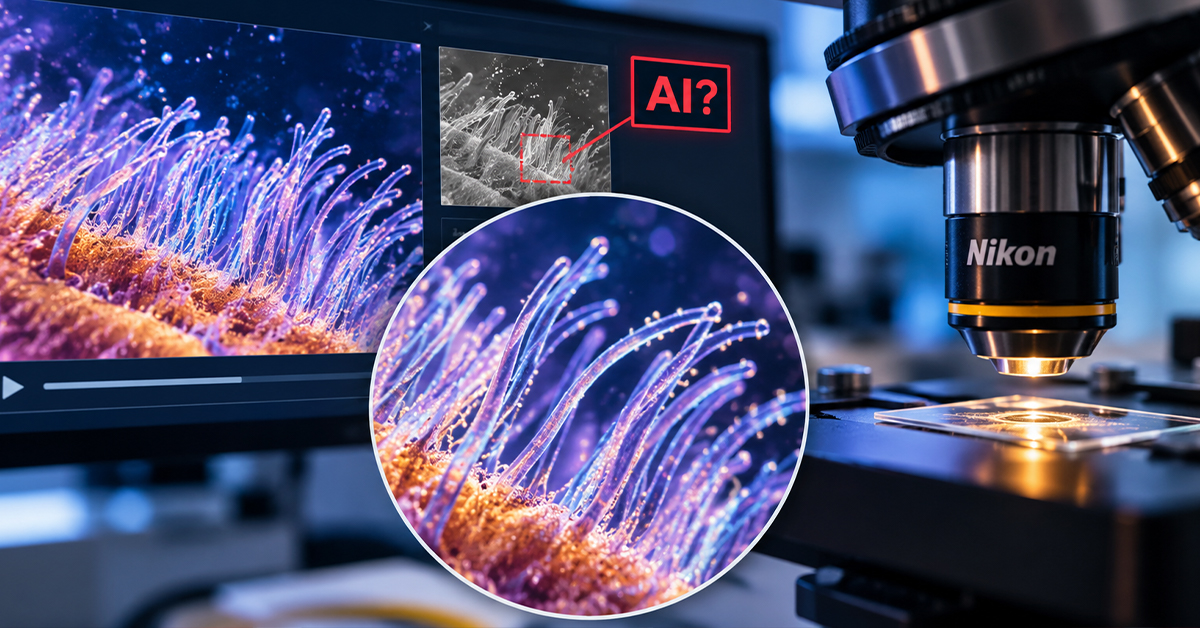
A winning video in Nikon’s Small World in Motion microscopy competition has sparked debate over the use of artificial intelligence (AI) in scientific imaging. Researchers have questioned the footage’s authenticity, while the entrant, Dr. Ning Xu, says AI helped visualize image data rather than generate the microscopic video.
The dispute raises an important question: how can judges distinguish legitimate image processing from AI-generated details? The answer matters because scientific images can serve as evidence of real biological processes, not simply as visual illustrations.
What Triggered the Nikon AI Controversy?
The disputed entry, submitted by Dr. Ning Xu of Tsinghua University, reportedly shows tiny hair-like structures called cilia moving in the airways of a child with a rare medical condition.
Researchers who examined the video raised concerns about unusual visual features. Some reportedly observed structures that appeared to pop in and out of existence, while another critic claimed to have noticed a possible generative AI watermark in a source image.
These observations prompted questions about how the footage was produced. However, visual irregularities and an alleged watermark do not independently prove that generative AI was used. Establishing the production process requires technical evidence, including information about the original recordings and the methods applied to them.
Image Processing vs. Generative AI: What Is the Difference?
Microscopy images often need computational processing before researchers can interpret them. Software may help reduce noise, reconstruct images, distinguish structures, or make faint details easier to see.
These methods can improve the visibility of information captured by an imaging system. Their results, however, depend on the processing techniques used and how faithfully they preserve the original data.
Generative AI presents a different issue. Depending on the system and its application, it can synthesize visual details rather than simply clarify information recorded by an instrument. If generated details are presented as direct observations, viewers may not be able to tell measured evidence from artificial content.
That distinction is central to the Nikon dispute. The question is not merely whether AI played a role, but whether the processing preserved the underlying experimental information and complied with the competition’s rules.
What Did Dr. Ning Xu Say, and What Is Nikon Reviewing?
Dr. Xu has denied using generative AI to create the experimental video, the cilia, or their movement. According to the research brief, he said AI was used to distinguish and visualize features in reconstructed grayscale images.
Critics have questioned whether the final visual results are consistent with authentic microscopic recordings. Resolving the disagreement would require examining the original microscope data, reconstruction methods, software settings, and processing workflow.
The research brief says Nikon’s competition rules prohibit using generative AI to create submitted content. Nikon reportedly stated that it had not identified a rule violation at the time of its response and was reviewing technical documentation supplied by Dr. Xu.
That reported statement is a preliminary position, not a final determination. The available brief does not establish the outcome of the investigation or provide the technical documentation needed to independently assess the competing claims.
Why the Debate Matters for Scientific Imaging
AI-assisted tools can help researchers examine complex images, but scientific communication depends on distinguishing recorded observations from computationally reconstructed or generated content.
For competition organizers and scientific publishers, clear rules and transparent documentation can help reviewers assess image authenticity. Access to original data and an understandable explanation of processing steps may be especially important when an image is challenged.
The Nikon controversy also illustrates why AI policies need to address more than a simple yes-or-no question about AI use. Different tools perform different functions, and the effect of a processing method on the underlying evidence matters.
What Readers Should Know
- The central allegation remains unresolved: Researchers have raised concerns about the winning video, but the supplied information does not establish that generative AI was used in violation of the rules.
- AI processing and AI generation are different: Image enhancement or reconstruction does not automatically mean that visual content was artificially generated.
- Technical evidence is essential: Original recordings and documented processing methods are important for evaluating the footage and the claims surrounding it.
Conclusion
The Nikon Small World in Motion controversy highlights the growing challenge of evaluating AI-assisted scientific images. Dr. Xu disputes the allegations, while Nikon’s reported review had not reached a definitive conclusion in the available research. Until technical findings are made public, the question of whether the entry violated competition rules remains open.
Sources and Further Reading
The supplied research brief did not include working, direct source links for the main claims. The following links were provided for background material about other microscopy competition entries: