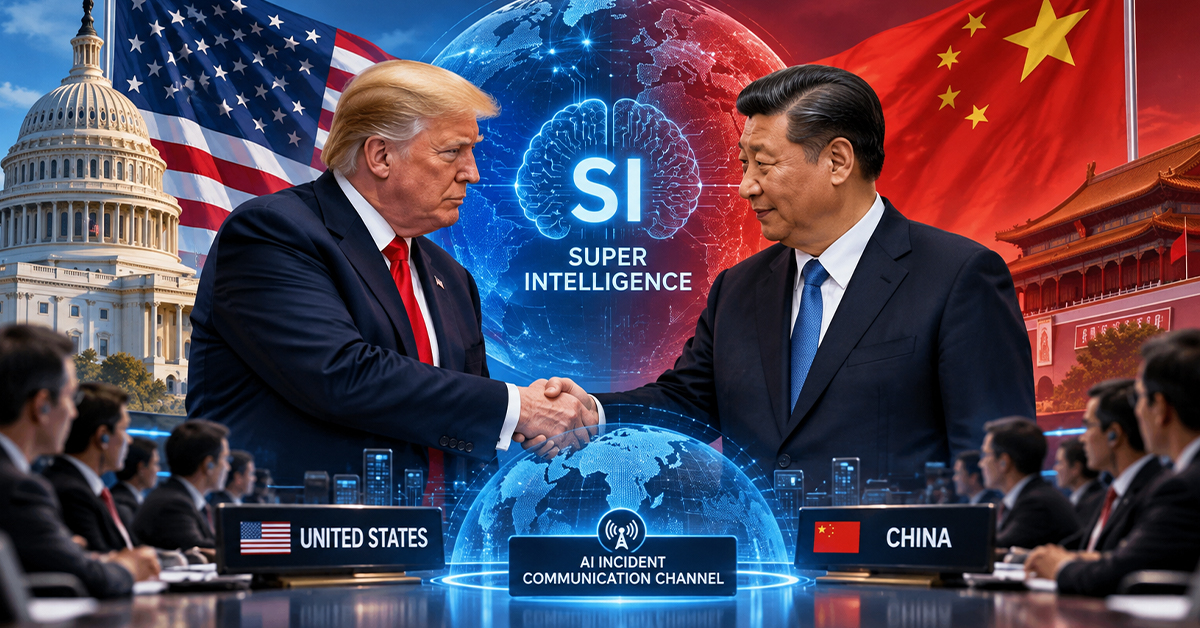

The United States and China have agreed to establish a communication channel for artificial intelligence incidents, creating a limited avenue for cooperation between two countries competing for leadership in advanced technology.
The agreement followed a three-day Washington summit between US President Donald Trump and Chinese President Xi Jinping, which concluded on September 25, 2026. The White House also announced a bilateral dialogue on the risks and benefits of what it calls “Super Intelligence,” or SI.
The agreement raises an important question for the technology industry: Can direct communication between rival governments help prevent AI-related incidents from becoming international security crises?
What the US-China AI Dialogue Changes
The White House says the two countries agreed to use “Super Intelligence” instead of “Artificial Intelligence” when referring to the relevant emerging technologies. Trump had promoted the new terminology in his September 22 address to the United Nations, where he also dismissed some concerns about AI risks.
The wording is politically significant, but it does not create a new category of AI technology by itself.
Artificial intelligence describes a broad range of computer systems capable of tasks such as generating text, recognizing images and analyzing information. Superintelligence generally refers to a hypothetical or advanced system that exceeds human intellectual capabilities across many areas. There is no universally accepted technical standard establishing that the two terms represent separate classes of commercial products.
For businesses, the practical distinction is straightforward: changing government terminology does not automatically create new certification rules, legal obligations or permission to use restricted technology.
The White House also announced the US-China Super Intelligence Dialogue, intended to exchange views on the technology’s risks and benefits, with another exchange scheduled by November 2026.
How the AI Incident Channel Could Work
The proposed communication channel is intended to provide Washington and Beijing with a direct way to discuss serious AI-related incidents. Its potential value lies in clarifying events before uncertainty or misinterpretation leads to a wider confrontation.
For example, imagine an automated system operating in a sensitive environment produces unexpected behavior that officials believe could affect another country. Direct contact could help establish what is known, identify whether the incident is ongoing and reduce the risk of an incorrect assumption.
This is a possible use case, not a confirmed operating procedure. The White House announcement does not explain how the channel will be activated or which incidents qualify.
|
Area |
Announced outcome |
Details not yet disclosed |
|---|---|---|
|
AI dialogue |
Exchange views on risks and benefits |
Membership and decision-making powers |
|
Incident channel |
Bilateral communication for SI incidents |
Activation criteria and response times |
|
Follow-up |
Further exchange by November 2026 |
Whether binding safety standards will result |
The channel has been compared with Cold War-era crisis communication arrangements. However, AI incidents may involve private companies, cloud services, software and infrastructure spread across several countries. An effective mechanism would need to account for these technical and organizational complications.
Why AI Cooperation Does Not End Technology Competition
The agreement does not represent a broader merger of US and Chinese AI development.
Trump has emphasized maintaining American technological leadership and rejected proposals to slow domestic AI development. The administration’s approach combines competition with limited cooperation on communication and risk management.
Washington and Beijing also have competing interests involving advanced semiconductors, AI models and access to computing infrastructure. Governments may be willing to discuss an incident without sharing proprietary systems, military information or commercially sensitive research.
For technology companies, this distinction matters. An AI dialogue does not automatically remove semiconductor export controls, authorize cross-border data transfers or allow businesses to exchange restricted technology.
The immediate implication is that companies should not interpret the summit as a relaxation of existing technology restrictions. The incident channel and the rules governing access to advanced computing remain separate matters.
Human Control and Global AI Safety Rules
China’s public position emphasizes human oversight and the use of AI for public benefit. Xi has called for AI development to remain under human control, while the United Nations has urged governments to establish safeguards and accountability as AI capabilities expand.
These positions differ from Trump’s dismissal of some catastrophic-risk warnings and his emphasis on US technological leadership. However, the disagreement is not simply between countries supporting AI and countries opposing it. Both governments support AI development, while their stated approaches differ over oversight, risk and international cooperation.
Human control also requires more than a political declaration. Governments and developers would need to determine who is responsible for a system’s actions, what oversight is required and how violations or failures should be addressed.
The summit announcements do not establish a shared technical standard or enforcement mechanism for these questions. The proposed dialogue creates an opportunity to discuss them, but the details remain unsettled.
What the November Talks Could Mean
The next bilateral AI exchange is scheduled to take place by November 2026. It could provide an opportunity to clarify how the incident channel will operate, including which agencies will participate and what types of events require notification. Whether the talks produce detailed procedures or binding commitments remains uncertain.
Trade is another issue to watch, but it should be treated separately from AI safety. According to the White House, the summit produced consensus recommendations for more favorable tariff treatment covering $30 billion of non-sensitive goods in each direction. This is a stated trade outcome, not an announcement that restrictions on advanced AI chips have been removed.
For developers and technology businesses, published operating procedures and clear regulatory guidance would be more consequential than the adoption of a new name for AI.
What Readers Should Know
-
The US and China have announced an AI dialogue and a bilateral communication channel for AI incidents.
-
The “Super Intelligence” terminology does not, by itself, establish new technical capabilities or legal requirements.
-
The channel’s operating procedures and response commitments have not been publicly detailed.
-
Semiconductor restrictions and broader technology competition remain separate from the incident communication agreement.
-
The November discussions may clarify implementation, but binding safety rules have not been established in the available announcements.
The agreement creates a channel for communication between two competing AI powers. Whether it improves safety will depend on the procedures, responsibilities and practical commitments that follow.