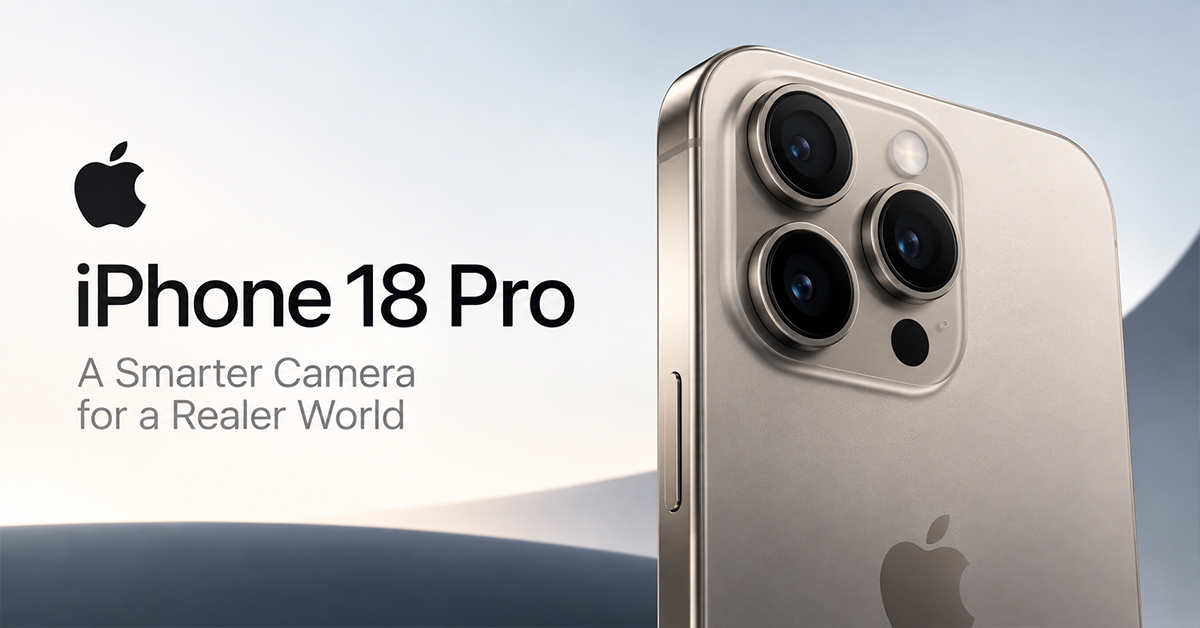
Apple’s iPhone 18 Pro introduces a major change to smartphone camera hardware: a mechanical variable-aperture system for its 48MP main camera. Instead of using one fixed lens opening, the camera can switch between four aperture settings depending on the shooting situation.
The change gives photographers more control over light and depth of field while also arriving with expanded manual controls and a new hardware-linked image-provenance system.
How the Variable Aperture Works
Most smartphone cameras use a fixed aperture and rely heavily on software to handle different lighting conditions. The iPhone 17 Pro, for example, used a fixed f/1.78 aperture on its main camera.
The iPhone 18 Pro adds physical aperture blades that change the size of the opening inside the main lens.
| Camera Feature | iPhone 18 Pro |
|---|---|
| Main camera | 48MP Fusion |
| Ultrawide | 48MP |
| Telephoto | 48MP, 8x optical range |
| Main aperture | f/1.48, f/1.8, f/2.8, f/4 |
The key change is the adjustable aperture. At f/1.48, the lens allows more light to reach the sensor, which can help the camera use faster shutter speeds in darker conditions. At f/4, the smaller opening can increase depth of field, keeping more of a scene in focus.
That gives the photographer a physical control over the lens rather than relying entirely on computational processing.
Why the Aperture Matters for Everyday Photos
The benefit becomes easier to understand with real shooting situations.
Imagine photographing people outdoors after sunset. A wider aperture can collect more light and may allow a faster shutter speed, reducing motion blur.
Now consider a group photo. With a very wide aperture, the depth of field can become shallow, making it harder to keep people at different distances equally sharp. Closing the aperture toward f/4 can increase the amount of the scene that remains in focus.
In simple terms:
Use a wider aperture when you need more light; use a narrower aperture when you want greater depth of field.
Whether that produces a dramatic improvement over Apple’s existing computational photography will require independent testing.
iPhone 18 Pro Adds More Manual Camera Control
The hardware change is accompanied by expanded Pro Controls.
The system provides manual adjustments for shutter speed and white balance, along with focus peaking and a live histogram.
Focus peaking highlights edges that are in focus, making manual focusing easier for photographers and video creators. The histogram provides a visual representation of brightness levels, helping users judge whether highlights or shadows are being pushed too far.
The research also reports handheld testing at shutter speeds of up to one second, although actual results will depend on the subject, stabilization and shooting conditions.
For casual users, these controls may remain mostly optional. For photographers and creators who want more predictable results, they provide greater control than a fully automatic camera interface.
Apple Reference Image Targets AI-Generated Media
Another less visible addition is Apple Reference Image, a hardware-linked system designed to provide information about an image’s origin.
According to the research brief, the system attaches hardware metadata when a photograph is captured, helping distinguish an original camera image from synthetic or AI-generated media.
That could become useful for wildlife photography, environmental documentation and other situations where proving an image’s origin matters.
There is an important limitation, however: image provenance is only useful if the associated information remains intact and can be verified after an image is copied, edited or shared.
Whether third-party photography apps can access the system or its metadata is [NEEDS VERIFICATION].
Hardware and Software Work Together
Variable aperture does not replace computational photography. Instead, it gives Apple’s image-processing system another physical input.
The camera still depends on the sensor, optics, stabilization and software working together to produce the final photograph.
Apple is also introducing Photographic Styles 3 with iOS 27, including adjustable skin texturing and AI-distributed film grain options.
For creators, this combination could be more useful than simply increasing camera resolution. The aperture changes how the lens captures light before software processing begins, while the manual controls give users more influence over the final result.
What Still Needs to Be Tested
The biggest unanswered question is how much the new hardware will improve everyday photography.
A mechanical aperture introduces moving parts into a smartphone, so long-term durability will need to be established. Independent testing will also show whether the wider f/1.48 setting provides a noticeable advantage in low light and whether switching to f/4 produces useful depth-of-field improvements.
The effectiveness of Apple Reference Image also depends on how widely the provenance information can be preserved and verified.
For most users, the iPhone 18 Pro may not require a completely different photography style. But for people who shoot manually, photograph challenging scenes or create video content, the variable aperture represents a more meaningful hardware change than another simple megapixel increase.
What Readers Should Know
The iPhone 18 Pro‘s most significant camera change is its four-step mechanical variable aperture, not the 48MP resolution alone.
The f/1.48 setting can provide more light in darker scenes, while f/4 can increase depth of field. Expanded Pro Controls add manual tools for photographers and creators, while Apple Reference Image addresses the growing need for image provenance.
The technology is promising, but its real-world advantage, mechanical durability and third-party support still need independent verification.