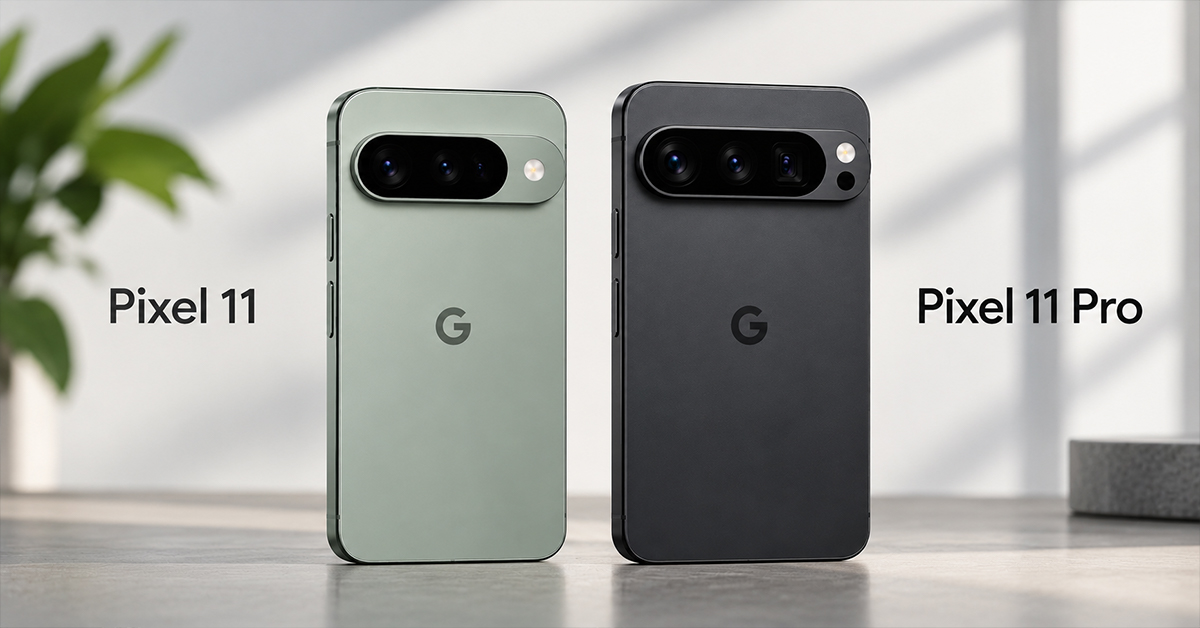

Google’s Pixel 11 and Pixel 11 Pro share the same 6.3-inch form factor and Tensor G6 processor, but the two phones take different approaches to the flagship experience. The Pro model costs $170 more in the U.S., with the extra hardware focused mainly on cameras, display technology and wireless connectivity.
For everyday performance and battery life, however, the gap is much smaller than the price difference suggests.

Pixel 11 vs. Pixel 11 Pro: The Key Differences
Both phones were announced on August 12, 2026 and released August 20. They feature 6.3-inch displays, aluminum frames, Gorilla Glass Vitus 2 and IP68 protection.
| Feature | Pixel 11 | Pixel 11 Pro |
|---|---|---|
| Price | $899 / £799 | $1,069 / £954 |
| Processor | Tensor G6, 3nm | Tensor G6, 3nm |
| Base RAM | 12GB | 12GB |
| Display | 1080 × 2424, 60/120Hz | 1280 × 2856, LTPO 1–120Hz |
| Main camera | 48MP, 1/1.56″ | 48MP, 1/1.3″ |
| Ultrawide | 13MP | 50MP with AF |
| Telephoto | 10.9MP, 5x | 50MP, 5x |
| Wireless connectivity | Wi-Fi 6 | Wi-Fi 7 + UWB |
| Battery | 4,985mAh | 4,850mAh |
| Wireless charging | 25W Qi2.2 | 25W Qi2.2 |
The most important point is that both phones use the same Tensor G6 and start with 12GB of RAM. The Pro’s higher price therefore goes toward other hardware rather than a faster processor.
Tensor G6 Performance Is Nearly the Same
Both models use Google’s 3nm Tensor G6 with a 7-core CPU and Imagination Series C GPU. The supplied benchmark results are also very close, with AnTuTu v10 scores around 1.41–1.46 million and Geekbench 6 scores around 7,415–7,429.
The research material also cites Google’s claim of a 50% increase in AI computing power. That figure is a company claim, rather than an independent measurement.
Tensor G6 is particularly focused on on-device AI, voice processing and computational photography. The available testing also points to weaker results in demanding 3D gaming than some competing flagship chips.

Camera Hardware Is the Biggest Pro Upgrade
The camera system is where the Pixel 11 Pro separates itself most clearly.
The Pixel 11 has a 48MP main camera, 13MP ultrawide and 10.9MP 5x telephoto. The Pro uses a larger 48MP main sensor, a 50MP ultrawide with autofocus and a 50MP 5x telephoto.
The Pro also offers up to 120x Pro Zoom and a 42MP front camera, compared with 10.5MP on the standard Pixel 11.
The larger sensors and higher-resolution cameras provide more hardware for detailed zoom and other demanding photography situations, although the supplied research does not establish that every type of photo will be better.
There is one notable exception: testing in the research found that the standard Pixel 11 produced better 2x close-up photos using its main camera.
Display and Connectivity Differences
The Pixel 11 Pro uses an LTPO OLED panel with a variable 1–120Hz refresh rate, while the standard model uses 60/120Hz.
LTPO allows the display to reduce its refresh rate when high refresh rates are unnecessary, which can potentially improve efficiency. However, the supplied research does not establish how much battery savings this provides in everyday Pixel 11 Pro use.
The Pro also has higher display resolution and higher measured peak brightness.
Connectivity is another hardware difference. The Pixel 11 supports Wi-Fi 6, while the Pro adds Wi-Fi 7 and Ultra Wideband (UWB), which enables more precise tracking and location-related features.

Battery Life Doesn’t Separate the Two
Battery capacity actually favors the standard Pixel 11 on paper: 4,985mAh versus 4,850mAh for the Pro.
More importantly, both models recorded the same 15 hours and 40 minutes of active-use battery life in the supplied testing data.
Both support 30W wired charging and 25W Qi2.2/Pixel Snap wireless charging. Independent testing cited in the research measured a full charge in approximately 79–80 minutes.
That makes battery life and charging relatively minor differences between the two models.
What Readers Should Know
- Performance: Both phones use Tensor G6 and deliver very similar benchmark results.
- Camera: The Pro has substantially upgraded camera hardware, particularly for ultrawide, telephoto and selfie photography.
- Display: The Pro adds LTPO, higher resolution and higher measured brightness.
- Connectivity: Wi-Fi 7 and UWB are key Pro-only connectivity upgrades in the supplied specifications.
- Battery: Despite different battery capacities, both recorded the same 15:40 active-use result.
For users who mainly care about everyday apps, communication and standard smartphone photography, much of the core Pixel experience is shared between the two models. The Pro’s additional cost is more closely tied to its camera, display and connectivity hardware.
Editorial Verification Notes
- Google’s claimed 50% increase in AI computing power for Tensor G6 should be verified against official documentation.
- Real-world durability of the Pro’s specialized screen coating requires further testing.
- Long-term battery impact from the Highlight LED feature requires verification.
- Future expansion of Highlight notification support should be confirmed.
- The practical performance benefit of Zoned UFS 4.0 on 512GB+ models remains uncertain.