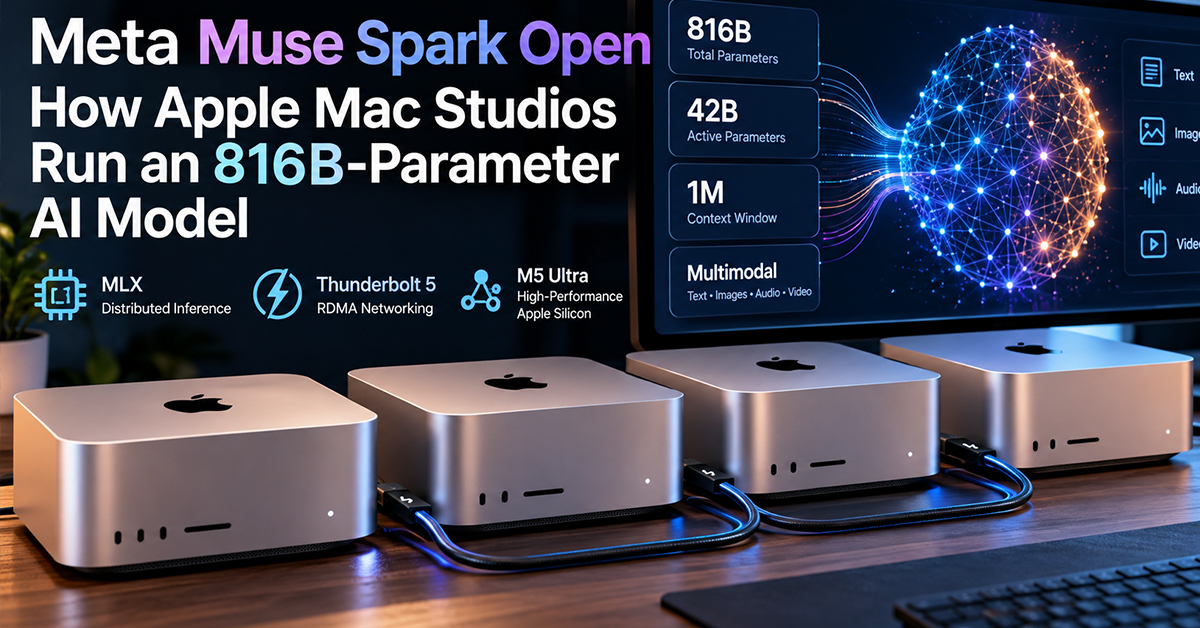
Meta released Muse Spark Open on October 15, 2026, an open-weight multimodal AI model with 816 billion total parameters. Research published by Apple the same day demonstrates how multiple Mac Studio computers can run the model locally using Apple’s MLX framework and low-latency Thunderbolt 5 networking.
The results show that desktop hardware can support exceptionally large AI models when memory and computation are distributed across machines. However, the setup requires multiple high-memory computers rather than a single desktop.
Muse Spark Open: Architecture and Capabilities
Muse Spark Open uses a mixture-of-experts (MoE) architecture, with 816 billion total parameters and approximately 42 billion active parameters per token. It supports a context window of up to one million tokens and accepts text, images, audio and video as input. Its output is text.
Activating only a subset of parameters per token reduces computation compared with activating the entire model. However, the complete model weights still require substantial memory.
Meta positions the model for coding, complex reasoning and agentic workflows, in which AI systems plan tasks and use tools over multiple steps. Its reported demonstrations include modifying an open-source iOS application and operating video-editing software. These are company-reported examples rather than independent evaluations of real-world performance. Meta’s announcement.
How MLX and Thunderbolt 5 Enable Distributed Inference
Apple’s MLX framework enables machine-learning workloads on Apple silicon. Its distributed inference features divide computation across multiple Mac Studios, allowing models that exceed a single machine’s memory capacity to run locally.
Two techniques are central to this approach:
- Pipeline parallelism: Each computer processes a different group of model layers in sequence.
- Tensor parallelism: Computers share the computation within model layers, potentially increasing generation speed.
Apple’s implementation uses RDMA over Thunderbolt 5, a low-latency communication method supported by macOS 26.2. MLX version 0.30.1 and later uses a communication component called jaccl to coordinate distributed workloads over a Thunderbolt mesh with two cables between connected machines.
The model is evaluated in four-bit NVFP4 quantization, reducing its reported memory footprint to approximately 493 GB. Native BF16 model weights alone require more than 1.6 TB. Because inference also needs memory for intermediate computations, one Mac Studio with up to 512 GB of unified memory is insufficient. Apple’s technical explanation.
Performance Benchmarks: What the Numbers Mean
Apple benchmarked Muse Spark Open alongside two dense models, Mistral Medium 3.5 and Qwen 3.8. The following figures are from Apple’s reported 65,536-token context tests, generating 128 output tokens.
| Model and configuration | Time to first token | Generation speed |
|---|---|---|
| Muse Spark Open, 2 M5 Ultra (pipeline) | 8.4 seconds | 15.74 tokens/s |
| Muse Spark Open, 2 M5 Ultra (tensor) | 8.2 seconds | 24.99 tokens/s |
| Muse Spark Open, 4 M5 Ultra (tensor) | 4.8 seconds | 36.73 tokens/s |
| Mistral Medium 3.5, 1 M5 Ultra | 24.6 seconds | 7.70 tokens/s |
| Qwen 3.8, 1 M5 Ultra | 4.1 seconds | 19.69 tokens/s |
Source: Apple Machine Learning Research. Results depend on the test configuration.
Time to first token (TTFT) measures how long a model takes to produce its first output token after receiving a prompt. Generation speed measures how quickly subsequent tokens are produced.
Apple attributes performance improvements partly to the M5 Ultra’s GPU Neural Accelerators and 1.2 TB/s of unified memory bandwidth, up from 819 GB/s on the M3 Ultra. These figures describe specific benchmarks; they do not establish that Muse Spark Open is faster or more capable than every competing model.
Hardware Costs, Licensing and Practical Limitations
Running Muse Spark Open locally requires a multi-machine setup, compatible software and significant memory capacity. The research does not provide a verified total purchase price for a two- or four-machine cluster, so the financial practicality cannot be assessed from benchmark results alone.
The model is distributed under Meta’s Muse Model License, which Meta describes as having limited commercial terms. Developers and businesses should review the actual license and usage policy before deployment.
Local inference can reduce the need to send prompts and code to an external inference provider. However, privacy also depends on application behavior, network configuration and other connected services.
What Readers Should Know
- The technical milestone: An 816-billion-parameter model can run across multiple Mac Studios using distributed inference.
- The practical benefit: Developers can experiment with large AI workloads locally, with reported generation speeds reaching 36.73 tokens per second in Apple’s four-machine benchmark.
- The main limitation: Memory requirements, multi-machine hardware costs, configuration complexity and licensing terms remain important barriers.
Conclusion
Muse Spark Open demonstrates how distributed inference can extend desktop AI capabilities beyond the limits of a single computer. Apple’s MLX framework and Thunderbolt 5 networking make local execution of an 816-billion-parameter model possible, but the setup remains a specialized development system rather than a straightforward upgrade for ordinary desktop users.