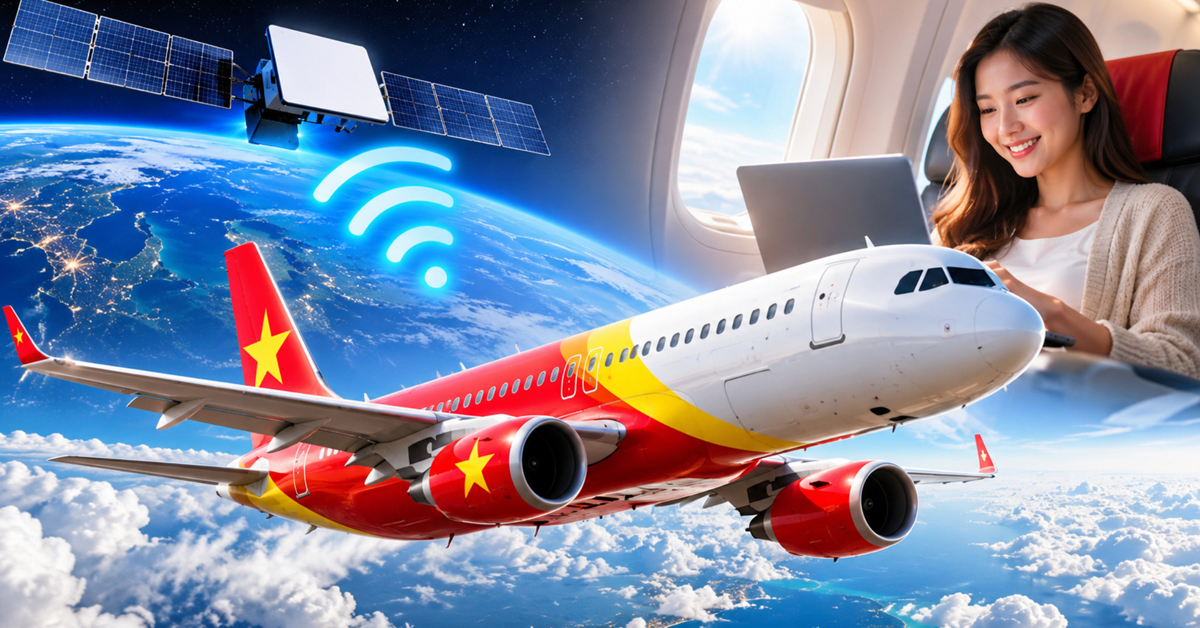
Vietjet plans to introduce Starlink satellite internet across an initial fleet of 120 aircraft, with the aim of providing passengers with free onboard Wi-Fi on domestic and international flights.
The Vietnamese airline’s agreement with Starlink could bring internet access to flights over oceans and remote areas where conventional mobile networks are unavailable. However, the service is not yet operational, and its rollout will depend on aircraft installations, aviation approvals, and network performance.
Vietjet’s Starlink Agreement Covers 120 Aircraft
Vietjet, Galaxy Holdings, Galaxy Telecom, and Starlink signed a strategic partnership agreement on September 23, 2026, during Vietnamese President To Lam’s visit to the United States. The partnership aims to provide complimentary high-speed Wi-Fi on Vietjet flights, beginning with an initial fleet of 120 aircraft.
The initial plan covers 120 aircraft: 100 narrow-body Airbus A321 and Boeing 737 aircraft, alongside 20 wide-body Airbus A330 aircraft. Vietjet also intends to equip newly delivered aircraft in the future.
According to the supplied research brief, commercial testing and the initial rollout are targeted for late 2026 to early 2027.
The airline intends to provide Wi-Fi without charging passengers separately. However, Vietjet has not confirmed which routes or aircraft will receive the service first, so travelers should not assume that every flight will offer Starlink connectivity when the rollout begins.
How Starlink Could Improve In-Flight Internet
The main technical difference between Starlink and traditional satellite internet is the distance signals must travel.
Geostationary satellites operate approximately 35,000–36,000 kilometers above Earth. Starlink’s low-Earth orbit (LEO) satellites operate at approximately 550 kilometers, reducing the distance between aircraft and satellites.
|
Satellite technology |
Approximate altitude |
Latency cited in the research brief |
|---|---|---|
|
Geostationary satellites |
35,000–36,000 km |
Around 600 ms |
|
Starlink LEO satellites |
Around 550 km |
20–40 ms |
Latency measures the time required for data to travel to a destination and back. Lower latency can make video calls, interactive websites, and cloud-based applications more responsive.
For passengers, this could make working online, sending messages, and attending virtual meetings more practical during flights. The figures above are general benchmarks, not guaranteed performance measurements for Vietjet aircraft.
How Starlink Works at Cruising Altitude
Starlink uses electronically steered phased-array antennas mounted on aircraft to maintain connections with satellites as the plane moves.
When an aircraft moves beyond one satellite’s coverage, the system transfers the connection to another. This process, called a handoff, helps maintain connectivity during flight.
Data can travel through satellite-to-satellite laser links or ground gateway stations connected to terrestrial networks. This allows aircraft to connect even when flying far from mobile phone towers.
The research brief cites potential bandwidth of up to 350 Mbps per aircraft under the planned Vietjet configuration. Starlink Aviation’s wider service is also cited as reaching up to 500 Mbps, but this should not be interpreted as a guaranteed speed for Vietjet passengers.
Importantly, aircraft bandwidth is shared among connected users. Individual speeds can vary depending on passenger demand, network congestion, satellite coverage, and onboard equipment.
Vietjet has not yet disclosed whether it will introduce speed limits, fair-use policies, or restrictions during periods of heavy usage.
The Cost of Offering Free Wi-Fi
Although passengers may not pay directly for connectivity, satellite internet represents a recurring expense for airlines.
The research brief cites Starlink Aviation pricing benchmarks of approximately $13,000 per month per aircraft for Regional Unlimited service and $20,000 for Global Unlimited service.
At the higher benchmark, annual connectivity costs would amount to approximately $240,000 per aircraft, before installation and other operating expenses. These figures are indicative pricing benchmarks, not confirmed terms of Vietjet’s agreement.
Vietjet has also approved a 250 billion Vietnamese dong capital increase for Galaxy Pay, raising its capital from 50 billion to 300 billion dong. The supplied research describes the move as supporting satellite internet through the airline’s digital ecosystem.
However, the airline has not publicly detailed how it will recover the cost of providing free Wi-Fi. Potential revenue from digital services or partnerships remains speculative unless Vietjet confirms such arrangements.
The financial implications will become clearer when the airline discloses its commercial terms, operating costs, and any passenger usage policies.
When Will Vietjet Passengers Get Starlink Wi-Fi?
Starlink Services Vietnam received licenses for satellite telecommunications services in February 2026. However, the installation and aviation certification schedule for individual Vietjet aircraft has not yet been confirmed.
These developments provide a foundation for its local operations, but the aviation certification schedule for individual Vietjet aircraft remains unconfirmed.
For passengers, the next important announcements will concern the first participating routes, installation schedules, actual connection speeds, and whether free Wi-Fi will be available consistently across the fleet.
Until those details are confirmed, the late 2026 to early 2027 timeframe should be treated as a target rather than a guaranteed launch date.