Apple’s iPhone 18 Pro and iPhone 18 Pro Max are not defined by a single headline feature. Their more interesting changes are spread across the processor, thermal system, camera, battery, and software.
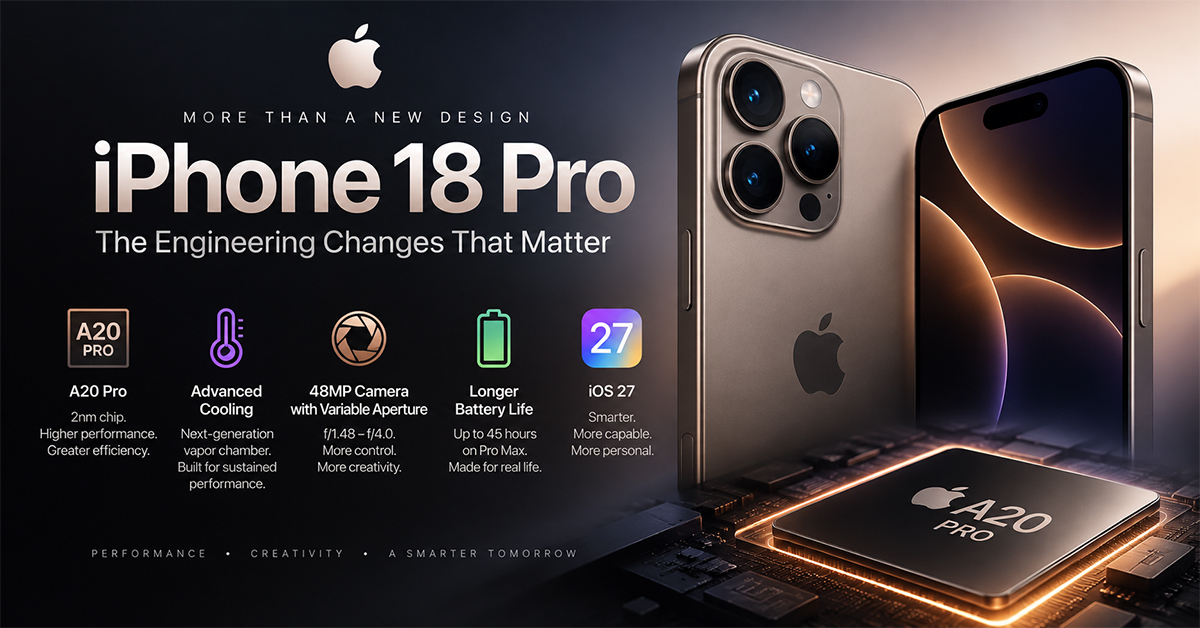
The new Pro models introduce Apple’s A20 Pro chip, a redesigned vapor-chamber cooling system, and a 48MP Fusion Main camera with a physical variable aperture. Apple also says the phones deliver its highest sustained performance in an iPhone to date, while the Pro Max gets a major battery-life increase.
That combination points to a broader trend in smartphone design: as processors and cameras become more capable, manufacturers increasingly have to solve problems involving heat, sustained performance, and user control rather than simply adding more raw specifications.
For buyers, that makes the iPhone 18 Pro worth examining beyond its exterior design.
iPhone 18 Pro: The Key Hardware Changes
Apple’s official specifications confirm several major changes in the new Pro models.
| Feature | iPhone 18 Pro / Pro Max |
|---|---|
| Chip | A20 Pro |
| CPU | 6-core |
| GPU | 7-core with Neural Accelerators |
| Neural Engine | Dual 16-core Neural Engine |
| Main camera | 48MP Fusion Main |
| Main aperture | Variable aperture |
| Aperture settings | f/1.48, f/1.8, f/2.8, f/4.0 |
| Operating system | iOS 27 |
| Storage | 256GB, 512GB, 1TB, 2TB |
| Colors | Burgundy, Glacier, Silver, Black |
| U.S. starting price | $1,199 / $1,299 Pro Max |
The table separates confirmed specifications from claims that require independent testing. Apple officially lists the A20 Pro architecture, variable aperture, storage options, colors, and U.S. pricing.
One notable omission is RAM. The research brief lists 12GB, but Apple does not present RAM capacity as a headline specification in the official material cited here. It is therefore better not to use 12GB as a confirmed specification unless an authoritative technical source independently verifies it.
The Real Upgrade May Be the Thermal System
Modern smartphone processors face a simple physical limitation: heat.
A chip can deliver high peak performance for a short period, but sustained workloads create a different challenge. Gaming, long 4K video sessions, rendering, and demanding AI workloads can keep the processor under load for much longer than ordinary phone activities.
If temperatures rise too far, a device may reduce performance to manage heat.
This is why Apple’s emphasis on a next-generation vapor chamber matters. Apple says the A20 Pro and the new vapor chamber work together to deliver the highest sustained performance in iPhone history.
The supplied research brief goes further, describing a vapor chamber that is three times larger than the previous implementation, along with a nano-copper thermal sheet and a heat-sink mid-chassis.
Those internal design details are useful context, but they should be treated separately from Apple’s official headline specifications until independent teardowns or technical documentation confirm the exact construction.
The important question is not simply whether the cooling hardware is larger.
It is whether the phone can maintain higher performance for longer.
Why Sustained Performance Matters More Than Peak Performance
Peak performance is easy to understand: a processor completes a demanding task quickly.
Sustained performance is different.
Imagine two phones running the same game. One delivers extremely high performance for the first few minutes but reduces its output as temperatures rise. Another maintains a more consistent level of performance over a longer session.
For ordinary users, the difference may be difficult to notice.
For mobile gamers, video editors, photographers recording long clips, and other heavy users, it can be much more important.
Apple says the A20 Pro’s 7-core GPU is up to 40 percent faster than the A19 Pro. That is a GPU performance claim, not a blanket claim that the entire iPhone is 40 percent faster or that sustained performance improves by 40 percent.
That distinction is important when evaluating the new phone.
A20 Pro Moves Apple to 2nm
The A20 Pro is built using a 2-nanometer process, according to Apple. The chip has a 6-core CPU, a 7-core GPU with Neural Accelerators, and a Dual 16-core Neural Engine. Apple also says the chip provides 50 percent more memory bandwidth than the A19 Pro.
The move to a smaller process node is significant, but it should not be interpreted as a simple equation where smaller manufacturing automatically means a proportionally faster phone.
Real-world performance also depends on chip architecture, software optimization, memory bandwidth, power consumption, and thermal management.
That is one reason the cooling system matters so much. A faster chip is most useful when the phone can actually sustain the workload.
The Camera’s Biggest Change Is Not the 48MP Number
The iPhone 18 Pro’s main camera remains a 48MP system, but Apple has added something more unusual: a physical variable aperture.
The Fusion Main camera supports four aperture settings:
- f/1.48
- f/1.8
- f/2.8
- f/4.0
Apple says six laser-cut blades transition between the aperture settings and allow the camera to adjust for lighting and depth of field. Users can also manually select the aperture through the Camera app.
This is more significant than simply increasing megapixels.
Why a Physical Aperture Matters
Aperture affects how much light enters a camera and influences depth of field.
A wider aperture can be useful when there is less available light. Changing the aperture can also affect the optical characteristics of the image, including how much of the scene appears sharply focused.
Smartphones have traditionally relied heavily on computational photography to compensate for the limitations of their small camera systems.
The iPhone 18 Pro takes a different approach by combining computational processing with physical optical control.
That does not mean every photograph will look dramatically different.
In many situations, Apple’s image processing will remain a major part of the final result. The practical advantage of variable aperture is more likely to appear in situations where the photographer wants additional control over exposure and depth of field.
Independent camera testing will be needed to determine how noticeable those differences are in everyday shooting.
Manual Camera Controls Make the Feature More Useful
The physical aperture becomes more interesting when combined with Apple’s expanded Pro controls.
Apple says users can adjust settings such as:
- Aperture
- Shutter speed
- White balance
- Histogram
The Camera app also provides customizable access to frequently used settings.
For casual photographers, these controls may rarely be touched.
For creators, however, they can make the iPhone more flexible.
A histogram can help with exposure decisions. Manual shutter speed can provide greater control over motion and video. White-balance control can help maintain consistency across a sequence of shots.
The result is not a replacement for a dedicated professional camera, but it does give experienced users more control over the imaging process.
Apple Is Also Expanding Its Video Tools
The camera system is not limited to still photography.
Apple lists Dolby Vision recording up to 4K at 120 fps, Smart Focus Tracking, improved low-light video, and the ability to apply Cinematic mode effects after recording to supported video captured at up to 60 fps.
For creators, this may be more meaningful than a single camera specification.
A phone used for social media clips, interviews, travel videos, or short-form production benefits from a combination of image quality, focus tracking, exposure control, stabilization, and editing flexibility.
Battery Life: The Numbers Need Context
Apple’s official figures are substantial.
The iPhone 18 Pro can provide up to 36 hours of video playback, while the Pro Max can reach up to 45 hours on eSIM-only models. Apple also says the Pro Max can provide up to 30 hours of usage based on a new battery usage model using real-world data.
These figures should not be confused with guaranteed screen-on time.
Battery life depends on factors such as:
- Display brightness
- Cellular reception
- 5G usage
- Gaming
- Camera recording
- Video playback
- Background activity
- Temperature
Someone who spends hours gaming or recording video will experience a very different battery pattern from someone who mainly uses messaging and web browsing.
Independent battery testing will therefore be more useful for comparing real-world endurance.
Dynamic Island Gets More Practical
Apple has redesigned the Dynamic Island so it can display up to three Live Activities simultaneously.
The significance is less about the number three itself and more about how the feature can keep time-sensitive information visible.
Navigation, timers, delivery tracking, recording status, and similar activities can remain accessible without requiring users to repeatedly open an app.
For people who frequently multitask on their phones, that could make the Dynamic Island more useful as an information layer rather than simply a notification area.
iOS 27 Adds a Larger Software Dimension
The iPhone 18 Pro launches with iOS 27, which includes the next generation of Apple Intelligence and Siri AI.
Apple says Siri AI is rolling out in beta and can use personal context, onscreen awareness, and information across supported apps. iOS 27 also adds new Apple Intelligence features and other system improvements.
This makes the software an important part of the upgrade story.
A faster processor is useful, but the user ultimately experiences the processor through applications, camera processing, AI features, gaming, and other tasks.
For someone with an older iPhone, the combined change in hardware and software may therefore matter more than any individual specification.
iPhone 17 Pro vs iPhone 18 Pro: Where the Difference Matters
The upgrade question is different for someone coming from an iPhone 17 Pro than for someone using a much older model.
The iPhone 18 Pro adds a newer A20 Pro chip, variable aperture, updated camera controls, a next-generation vapor chamber, and additional software capabilities. Apple describes the new cooling system as part of the highest sustained-performance system it has put in an iPhone.
| User type | Potentially relevant changes |
|---|---|
| Mobile gamers | A20 Pro GPU and sustained performance |
| Video creators | Camera controls, focus tracking and thermal management |
| Mobile photographers | Variable aperture and Pro controls |
| AI-heavy users | Neural Engine and Apple Intelligence |
| Everyday users | Battery life, iOS 27 and overall camera improvements |
This is not a ranking of which users should upgrade. It simply shows where the new hardware is most directly relevant.
What About iPhone 14 Pro and 15 Pro Owners?
The difference becomes easier to evaluate when the starting point is an older generation.
A user coming from an iPhone 14 Pro or 15 Pro may be considering several upgrades at once: newer silicon, newer camera technology, newer software capabilities, improved battery condition, and additional camera controls.
But an upgrade should still be based on actual limitations.
If an existing phone remains fast enough, its battery is healthy, and its camera meets the user’s needs, there may be little practical reason to replace it immediately.
The calculation changes for users who regularly edit video, record long-form footage, play demanding games, or want greater control over mobile photography.
The Price Is No Longer an Estimate
This is one area where the original draft needed a significant correction.
Before launch, TrendForce estimated that the iPhone 18 Pro could start at $1,249–$1,299, compared with $1,099 for the iPhone 17 Pro.
But Apple has now published official pricing.
The iPhone 18 Pro starts at $1,199 in the U.S., while the iPhone 18 Pro Max starts at $1,299. Both models start with 256GB of storage.
That makes the final retail price lower than the pre-launch TrendForce estimate for the Pro model.
This is an important example of why analyst forecasts should not remain in a published article as though they were confirmed product specifications.
The Upgrade Question Depends on the User
There is no single specification that determines whether the iPhone 18 Pro is worthwhile.
For a casual smartphone user, the biggest benefits may come from battery life, camera improvements, and iOS 27.
For a photographer, the variable aperture and manual controls may be more important.
For a gamer or creator, sustained performance and thermal management could matter more.
And for someone upgrading from several generations back, the combined improvement across hardware and software may be more noticeable than any individual feature.
The useful question is therefore not simply:
“Is the iPhone 18 Pro better?”
It is:
“Which of its changes solve a problem I actually have with my current phone?”
What We Still Need to Learn
The official specifications answer many questions, but some important performance questions still require independent testing.
How effective is the new cooling system?
Apple says the next-generation vapor chamber helps deliver the highest sustained performance in iPhone history. Independent gaming, rendering, and long-duration recording tests can show how that translates into temperatures and sustained frame rates.
How noticeable is the variable aperture?
The hardware is confirmed, but its practical advantage should be measured across low-light photography, portraits, bright scenes, and video.
How close is real-world battery life to Apple’s ratings?
Official playback figures provide a useful benchmark, but mixed-use testing is necessary for a more realistic comparison.
How much difference does A20 Pro make outside benchmarks?
The A20 Pro’s GPU is officially rated up to 40 percent faster than the A19 Pro, but actual user experience will depend on workload, software, and thermal behavior.
The Bigger Trend: Smartphone Performance Is Becoming a Thermal Problem
The most interesting aspect of the iPhone 18 Pro may not be the headline specifications.
It is the engineering direction behind them.
As smartphone processors become faster and AI workloads become heavier, performance increasingly depends on how effectively a device can manage heat.
The same principle applies to cameras.
Better photography is no longer just about sensor resolution. It involves optics, image processing, AI, exposure control, focus, and software.
The iPhone 18 Pro brings these elements together in a way that reflects where premium smartphones are heading.
Final Takeaway
The iPhone 18 Pro is more than a processor upgrade or a camera refresh.
Its A20 Pro chip moves Apple to a 2nm process and introduces a 7-core GPU with Neural Accelerators and a Dual 16-core Neural Engine. Its camera adds a physical variable aperture, while the Pro controls give photographers more direct control over exposure and optics. Apple also says the new vapor chamber helps deliver its highest sustained performance in an iPhone.
Some of the most interesting claims still need independent testing, particularly the real-world impact of the thermal redesign and variable aperture.
But the direction is clear.
The next stage of smartphone innovation is increasingly about how different systems work together: processor, cooling, camera optics, software, AI, and battery.
For buyers, that means the best way to evaluate the iPhone 18 Pro is not by counting specifications. It is by identifying which of those engineering changes will actually improve the way they use their phone.