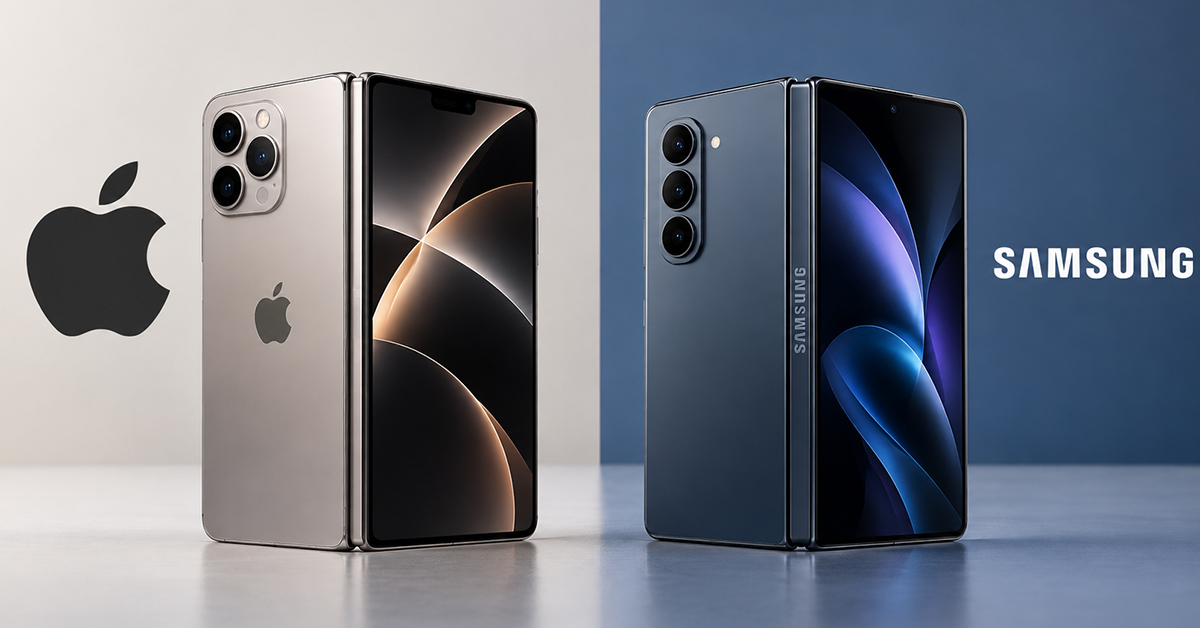

Apple’s entry into the foldable smartphone market was expected to create new pressure on Samsung. But early sales data from South Korea suggests something less predictable: Samsung’s Galaxy Z Fold8 sales reportedly increased in the week after Apple unveiled the iPhone Duo.
The reported increase does not prove that consumers rejected Apple’s first foldable iPhone. Instead, it raises a more interesting possibility. Apple may have expanded interest in foldable phones while some undecided buyers ultimately chose Samsung because of differences in price, availability and hardware design.
For a market that is still relatively small compared with conventional smartphones, that could be an important development.
A Quick Look at the Two Foldables
Before looking at the market reaction, the most relevant differences can be summarized simply:
| Feature | Samsung Galaxy Z Fold8 | Apple iPhone Duo |
|---|---|---|
| Product generation | 8th-generation Fold series | First foldable iPhone |
| Inner display | 7.6-inch | 7.6-inch |
| Outer display | 5.5-inch | 5.4-inch |
| Weight | 201g | 254g |
| Folded thickness | 9.7mm | 11.3mm |
| South Korea 256GB price | About ₩2.28 million | ₩3.29 million |
| Availability in South Korea | Already available | October 23, 2026 |
The table highlights why the two products can appeal to different buyers. Both offer a large foldable screen, but the reported Korean pricing and physical dimensions create a significant difference in the buying decision.
Apple’s Entry Gives Foldables a New Audience
Apple officially introduced the iPhone Duo as its first foldable iPhone. The device opens to a 7.6-inch inner display and has a 5.4-inch outer display.
That matters because Apple is not simply adding another premium smartphone to its lineup. It is bringing the foldable form factor into the iPhone ecosystem.
Samsung has already spent years developing book-style foldables. Apple is approaching the category from a different starting point, with a large installed base of iPhone users who may never have seriously considered a foldable device before.
That creates two possible effects.
Apple could take customers away from Samsung. But it could also persuade more people to consider foldables in the first place.
The second possibility is particularly important because the overall foldable market remains much smaller than the conventional smartphone market.
Galaxy Z Fold8 Sales Reportedly Rose 10%
According to South Korean telecommunications-industry reporting, Galaxy Z Fold8 sales increased by about 10% week over week following the iPhone Duo unveiling.
The figure is significant because Samsung might have expected some potential buyers to delay their purchase until they could see Apple’s alternative.
However, the 10% figure should be interpreted carefully.
It represents a short-term change in South Korea, not a global sales result. It also does not prove that every additional Samsung purchase was caused by Apple’s announcement.
Industry analysts have suggested that some consumers who had been waiting for Apple’s foldable may have decided to buy the Galaxy Z Fold8 after seeing the Duo’s price, specifications and launch schedule.
That is an explanation for the sales movement, rather than a directly measured consumer conclusion.
Price Creates a Large Difference in South Korea
Price is one of the clearest differences between the two products in South Korea.
The reported 256GB Galaxy Z Fold8 price is about ₩2.28 million, while the 256GB iPhone Duo is priced at ₩3.29 million.
That creates a difference of approximately ₩1.01 million.
For comparison, the reported U.S. starting prices are $1,899 for the Galaxy Z Fold8 and $1,999 for the iPhone Duo.
The competitive situation is therefore different depending on the market.
A $100 difference in the United States is relatively narrow for smartphones in this price category. A difference of more than ₩1 million in South Korea creates a much larger gap between the two products.
This does not automatically determine which phone consumers will choose. Brand loyalty, software, cameras, ecosystem features and other factors can matter just as much. But price clearly changes the value equation.
Weight and Thickness Are Also Part of the Competition
Foldable smartphones have an unusual design challenge.
When opened, they provide a much larger display. When closed, however, users still have to carry the complete device in a pocket or hold it in one hand.
That makes weight and thickness more noticeable than they might be on a conventional smartphone.
Samsung lists the Galaxy Z Fold8 at 201 grams and 9.7mm thick when folded. Apple lists the iPhone Duo at 254 grams and 11.3mm thick when folded.
That means the iPhone Duo is 53 grams heavier and 1.6mm thicker based on the manufacturers’ specifications.
Those numbers alone do not establish that one design is better. But they do show that Apple and Samsung made different hardware trade-offs in their first-generation and eighth-generation foldable designs.
For a consumer who prioritizes portability, the difference may matter. For another buyer, the Apple ecosystem or other device features may be more important.
Availability Gives Samsung an Immediate Advantage
There is another factor that is easy to overlook: timing.
Apple announced that the iPhone Duo would become available beginning October 23, with pre-orders starting October 16.
Samsung’s Galaxy Z Fold8, meanwhile, was already available.
That creates a straightforward situation for someone who has already decided to buy a foldable phone.
A consumer can purchase the Fold8 immediately or wait for Apple’s device and compare it in person later.
For buyers who are ready to upgrade now, the waiting period can become part of the purchasing decision.
It also means the current sales increase should not be treated as the final result of the Apple-Samsung competition. The situation could change once consumers can actually use and compare both devices.
Samsung Has an Experience Advantage in Foldables
The generational difference between the products is another important part of the story.
Samsung has been developing the Galaxy Z Fold line through multiple generations. The Fold8 represents years of refinement in the company’s book-style foldable design.
Apple is entering the category for the first time.
That does not automatically make Samsung’s product superior. A first-generation product can introduce a new approach, while an established product can also carry compromises from previous design decisions.
But consumers are effectively comparing two different development histories.
Samsung is selling the latest version of a mature foldable product line.
Apple is introducing a new form factor to an existing iPhone ecosystem.
That distinction may become more important as buyers move beyond specifications and start evaluating long-term everyday use.
Apple’s Biggest Impact May Be Bigger Than Its Own Sales
The most interesting possibility is that Apple could grow the entire foldable category.
Imagine a smartphone buyer who has never considered a foldable phone. Apple’s entry may make that person curious about the category.
That consumer could eventually buy an iPhone Duo, a Galaxy Z Fold8 or another manufacturer’s foldable.
In that scenario, Apple’s arrival does not simply redistribute existing foldable customers. It creates new demand.
This is why the South Korean sales reaction is interesting even though the available data is limited.
Samsung does not necessarily need Apple to fail for its own foldable business to benefit from Apple’s entry.
A larger foldable market could create opportunities for multiple manufacturers.
But the 10% Increase Is Only an Early Signal
The reported sales increase should not be interpreted as proof that Samsung has won the foldable competition.
Several important questions remain unanswered.
First, the reported increase covers South Korea rather than the global market.
Second, it is a week-over-week comparison rather than evidence of a long-term sales trend.
Third, the available reporting does not provide enough consumer-level information to determine exactly why each additional Fold8 purchase happened.
Most importantly, consumers had not yet had the opportunity to fully experience the iPhone Duo in stores when the sales increase was reported.
That makes the period after the October launch particularly important.
What to Watch After the iPhone Duo Launch
Once the iPhone Duo reaches consumers, the comparison will become more meaningful.
Buyers will be able to evaluate factors that specifications cannot fully explain, including:
- How comfortable the phone feels in everyday use
- How useful the foldable software experience is
- How well the hinge and displays perform over time
- How the two devices compare for multitasking
- Whether the iPhone ecosystem encourages existing iPhone users to switch to a foldable
- Whether Samsung’s price and hardware advantages remain persuasive
The answers will take longer to emerge than a single week’s sales data.
The Foldable Market Is Entering a Different Phase
Apple’s arrival changes the competitive environment, but it also changes the conversation around foldables.
Samsung has the advantage of multiple generations of foldable development and an established product line.
Apple brings the strength of the iPhone ecosystem and a huge existing customer base that may now have a reason to consider a foldable device.
The result could be more competition, but it could also mean a larger market for foldable smartphones overall.
The South Korean sales data is therefore best viewed as an early signal rather than a final verdict.
Conclusion
Apple’s first foldable iPhone has produced an unexpected early reaction in South Korea: Galaxy Z Fold8 sales reportedly increased by about 10% in the week following Apple’s announcement.
Price, weight, thickness and availability provide plausible reasons why some undecided buyers may have chosen Samsung. However, the available evidence does not establish that these factors were solely responsible for the sales increase.
The more important question is what happens after consumers can actually compare the two devices.
If Apple’s entry brings more people into the foldable market, Samsung could benefit even while facing a stronger competitor. If consumers instead move directly from Samsung to Apple, the effect will become clearer in later sales data.
For now, the iPhone Duo has done something that may be just as important as competing with Samsung: it has made the foldable smartphone category more visible to mainstream consumers.