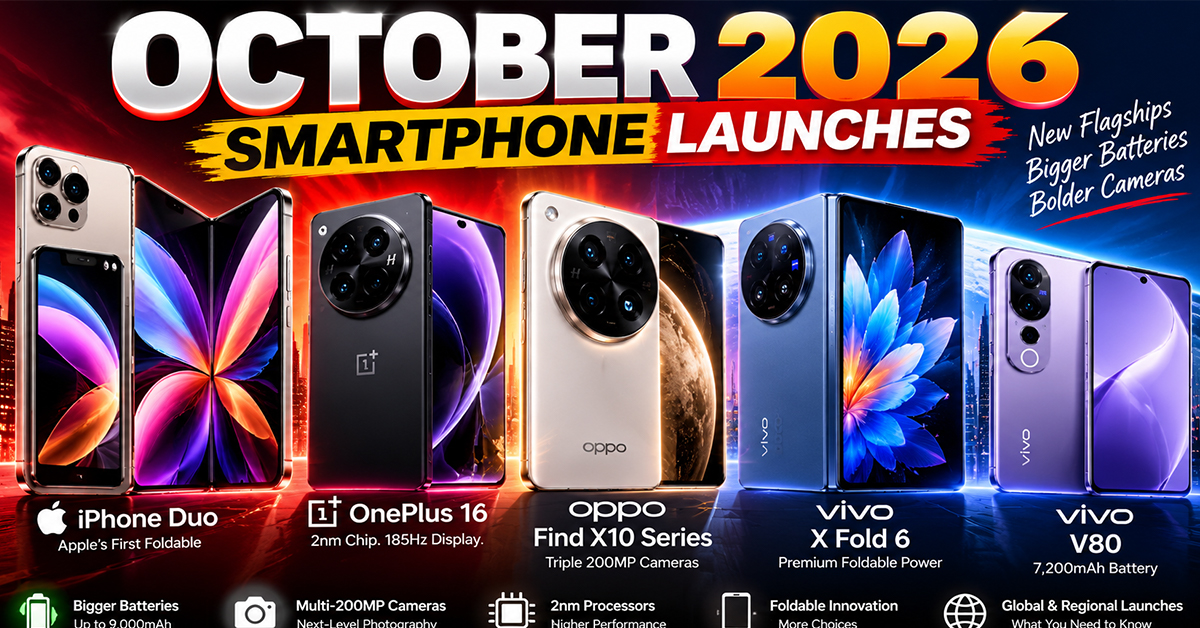

October 2026 is bringing several major smartphone launches, with manufacturers focusing on larger batteries, high-resolution cameras, fold able displays and faster processors. However, not every phone announced or reported for this month will be available worldwide, and some specifications remain unconfirmed.
For buyers considering a new smartphone, the important question is not simply which phone has the biggest numbers on its specification sheet. It is whether the improvements offer meaningful benefits and whether the device will actually be available in their region.
Which Smartphones Are Arriving in October 2026?
Several manufacturers have scheduled or reported launches throughout October. The Vivo V80 and Vivo S2 FE have confirmed Indian launch dates, while other flagship models have different release schedules and levels of confirmation.
The Vivo V80 is scheduled for October 6 in India. According to published launch information, it features a 6.59-inch OLED display with a 144Hz refresh rate, a 7,200mAh battery and 90W fast charging.
The OnePlus 16 is reported to launch in China on October 12. Its reported specifications include a high-refresh-rate display and a new Snapdragon processor. However, buyers should distinguish reported specifications from features confirmed by the manufacturer.
The Oppo Find X10 series has already debuted in China, according to technology reporting, with a wider international rollout expected later in October. The Vivo X Fold 6 is another device attracting attention as it expands beyond its initial Chinese market.
Apple’s reported iPhone Duo fold able is also featured in October launch coverage. However, its launch dates, pricing and specifications require stronger primary-source confirmation before consumers should rely on them.
Why Are Smartphone Batteries Getting Bigger?
Battery capacity has become a major selling point in the smartphone market. Some newer Android devices are reported to offer capacities of 7,000mAh or more, compared with the smaller batteries found in many established flagship phones.
One technology behind this trend is silicon-carbon battery chemistry. By incorporating silicon into the battery’s anode, manufacturers can potentially store more energy within a given amount of space.
This approach creates opportunities to increase battery capacity without proportionally increasing the phone’s size. It is particularly relevant for people who use their phones heavily for navigation, video streaming, photography and gaming.
However, battery capacity alone does not determine how long a phone lasts. Display brightness, processor efficiency, software optimization and network conditions also affect power consumption. Independent battery tests are therefore more useful than capacity figures alone when comparing devices.
What Do High-Resolution Cameras and Faster Displays Offer?
Another notable trend is the use of high-resolution camera sensors and displays with increasingly high refresh rates.
The Oppo Find X10 series has been reported to feature 200MP camera hardware, with the Pro Max model described as having three 200MP rear cameras. High-resolution sensors can provide additional image detail and flexibility when cropping photographs.
Nevertheless, megapixel counts do not automatically translate into better photographs. Sensor size, lens quality, image processing and performance in low light are equally important considerations.
High-refresh-rate displays offer a different benefit. A 144Hz screen, such as the one announced for the Vivo V80, can display motion more smoothly than a conventional 60Hz screen. This may be particularly noticeable when scrolling or playing compatible games.
The actual experience depends on whether applications support higher refresh rates and whether the phone can maintain them without excessive battery consumption.
What Should Buyers Check Before Purchasing?
Regional availability is one of the most important considerations when choosing an upcoming flagship. A phone launched in China may not receive an equivalent release in India, Europe or the United States.
Imported devices can also create practical complications involving network compatibility, software versions, warranty coverage and after-sales service. Buyers should check these details before ordering a phone from another market.
Pricing deserves similar attention. Several October launch reports include estimated prices based on leaks or currency conversions. These figures should not be treated as confirmed retail prices.
Consumers who do not urgently need a new phone may also benefit from comparing newly launched devices with existing models. A previous-generation flagship could offer a more attractive purchase price without sacrificing the features that matter most to a particular user.
Are October’s New Smartphones Worth Waiting For?
The answer depends on individual priorities. People who need longer battery life may want to examine phones with larger batteries, while mobile photographers may be more interested in camera hardware and image-processing capabilities.
Foldable devices appeal to a different audience, particularly people who want a larger working screen in a portable form. However, their value depends on pricing, durability, software support and the availability of suitable applications.
The Vivo V80’s announced battery and display specifications make it relevant to buyers interested in those features. Other models, including the OnePlus 16, Oppo Find X10 series and Vivo X Fold 6, deserve consideration as their regional availability and final specifications become clearer.
Ultimately, the most useful comparison is between confirmed retail products, independently tested performance and prices in the buyer’s own market. October’s launch announcements provide a reason to compare options, but they are not a substitute for verified product information.