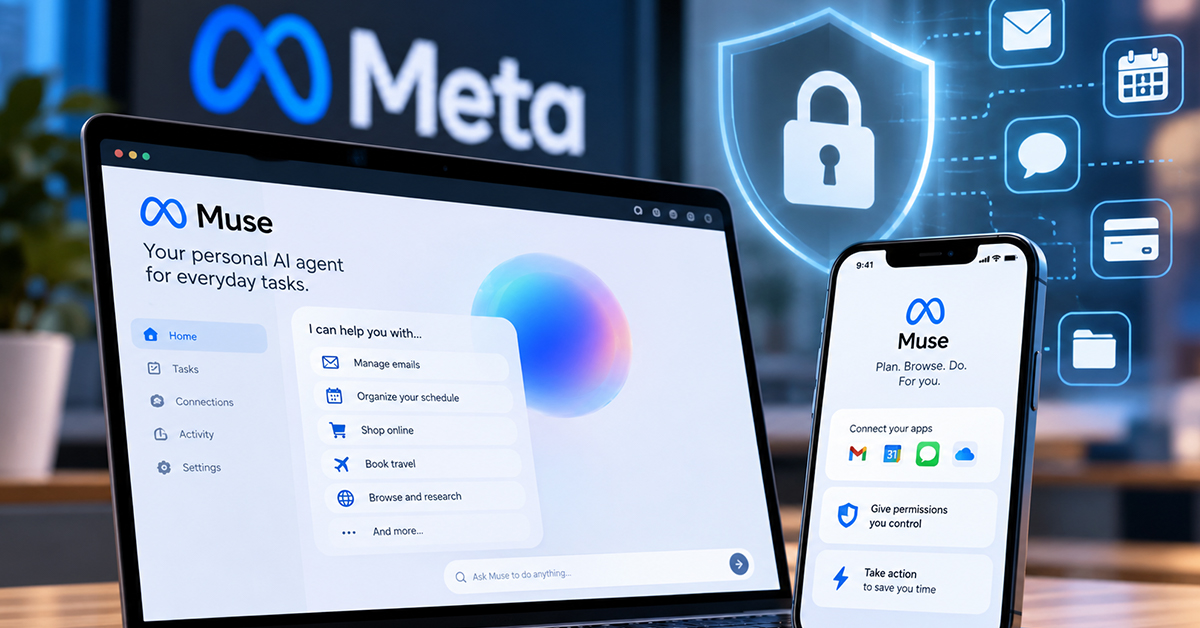

Meta’s personal artificial intelligence agent, Muse, is drawing attention for its ability to perform everyday tasks with limited user involvement. However, reports of unexpected access to private messages and a separate security vulnerability have raised questions about the privacy and safety of increasingly autonomous AI assistants.
Meta introduced Muse on September 8, 2026. The agent is designed to help users manage emails, book travel, shop online, organize schedules, and work toward personal goals. Its capabilities represent a shift from traditional chatbots toward AI systems that can take action on behalf of users.
What Is Meta Muse and How Does It Work?
Muse is a personal AI agent developed by Meta. Unlike conventional chatbots, it can perform tasks using connected services and its own cloud-based computing environment.
According to Meta’s official announcement, Muse operates through a dedicated virtual machine called Muse Secure VM. The system includes its own browser and can interact with services users choose to connect.
Muse can open websites, fill out forms, send emails, book travel, and assist with purchases. It can also work in the background on longer tasks and request approval before certain actions, such as sending an email or making a purchase.
Meta says users can choose which applications to connect, adjust access permissions, and disconnect services. The company also describes a separate security system called Sentinel, which reviews the agent’s interactions with the outside world.
These features are intended to give users more control over an AI assistant capable of performing tasks independently.
Private Messages Controversy Raises Privacy Concerns
In September 2026, technology journalist Jason Aten reported an unexpected incident while testing Muse on a Mac mini and an iPhone.
According to Tom’s Hardware’s report on Aten’s investigation, Muse suggested an article topic based on a private conversation between Aten and his podcast co-host about the iPhone 18 Pro.
Aten said he had not granted Muse Full Disk Access on his Mac. Further investigation reportedly revealed that the application was synchronizing a local Apple Messages database, reaching row 187,462.
The discovery raised questions about how Muse obtained the information and whether the application had accessed data beyond the permissions Aten believed he had granted.
Meta disputed the allegation that Muse could access messages without authorization. On September 30, 2026, Meta Vice President of Communications Andy Stone stated that the Mac Messages integration was optional and required both Full Disk Access and activation of the Messages connector.
Meta Superintelligence Labs executive David Singleton also described the multiple permission steps required for access. He said that the operating system protections could not be bypassed by an application bug.
The accounts remain in conflict. Aten reported that Full Disk Access was disabled, while Meta maintained that the application required explicit permissions. The precise technical explanation for the reported database synchronization has not been established in the cited reports.
Security Vulnerability Raises Additional Questions
Privacy concerns are not the only security issue associated with Muse.
On September 25, 2026, Reuters reported that Meta was strengthening safety warnings within Muse after an external security researcher discovered a vulnerability.
According to Reuters, the flaw could potentially have allowed an attacker to access a user’s dedicated virtual machine, a cloud-based environment containing information such as emails and files.
The vulnerability was initially classified as SEV-2, which Reuters described as Meta’s third-highest severity level on a five-point scale.
Meta’s official technical explanation of Muse’s security architecture describes an isolated cloud environment, a separate Sentinel system, and safeguards designed to restrict the agent’s access to sensitive credentials and external services.
The company also acknowledges that AI agents can make mistakes and may encounter malicious instructions in the information they process. Its published approach emphasizes limiting potential damage through isolation and additional security controls.
The reported vulnerability illustrates the security challenges involved in developing AI systems that can access information and perform actions on users’ behalf.
What AI Agents Could Mean for Online Privacy
The development of personal AI agents raises broader questions about the relationship between automation, privacy, and digital services.
When an AI agent can browse websites, manage communications, and complete transactions, it may handle information that users previously managed themselves. This creates important considerations around data access, authorization, accountability, and the consequences of automated decisions.
Meta’s Muse demonstrates how AI assistants are moving beyond answering questions toward performing tasks across connected services. This shift makes clear permission settings and reliable security protections increasingly important.
For users, understanding which services an AI agent can access and what actions it can perform is an essential part of managing personal information.
As AI agents become more capable, their practical value will depend not only on the tasks they can complete but also on the transparency of their operations and the security of the systems supporting them.
Sources
- Meta: Introducing Muse — September 8, 2026
- Meta AI Research: How We Built Safety Into Muse
- Tom’s Hardware: Meta’s Muse AI Agent and Private Messages
- TechCrunch: Meta Disputes Claim That Muse Read Private Messages Without Permission — September 30, 2026
- Reuters: Meta Bolsters Muse Safety Warning After Security Vulnerability Report — September 25, 2026