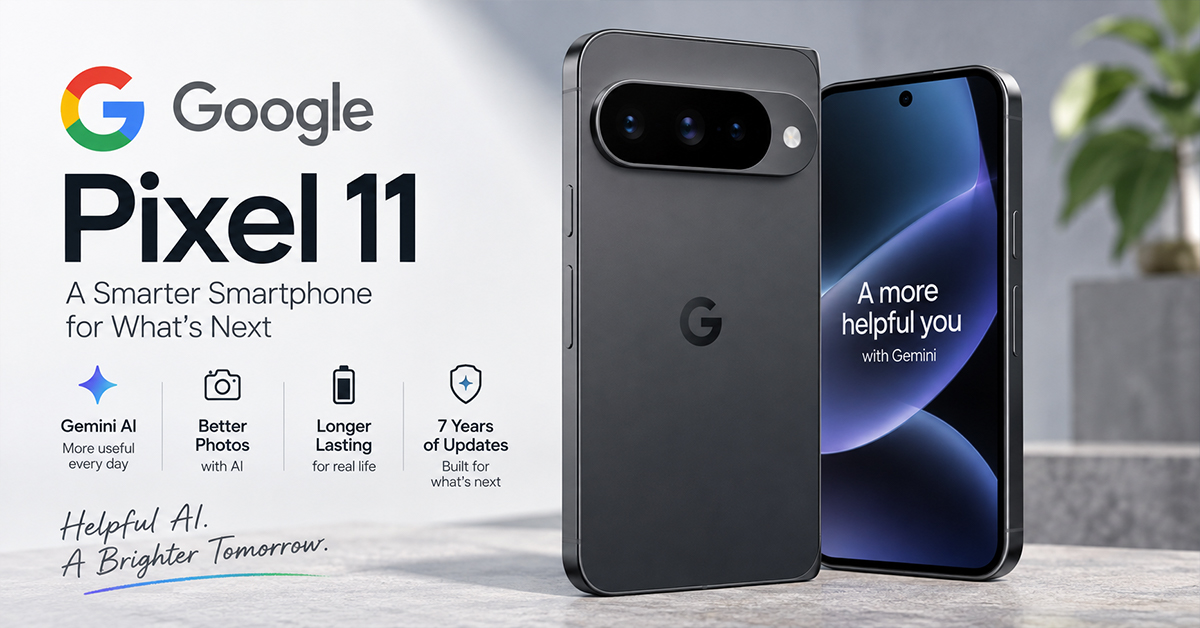

Google’s Pixel 11 is not a dramatic departure from the company’s recent smartphone formula. Instead, it represents a more deliberate shift toward making artificial intelligence a central part of the phone experience.
The $899 Pixel 11 combines Google’s Tensor G6 processor, Gemini-powered features, a 256GB starting configuration, upgraded cameras, faster wireless charging, and long-term software support. On paper, the hardware looks more refined than revolutionary.
That makes the Pixel 11 an interesting test of Google’s strategy: can better software and AI integration provide enough everyday value to justify a premium flagship price?
Pixel 11 Specifications at a Glance
The standard Pixel 11 comes with a 6.3-inch OLED display, 12GB of RAM, and 256GB of base storage. It also adds a 5x telephoto camera to the triple-camera system, giving the standard model capabilities that were previously more closely associated with higher-end phones.
| Specification | Google Pixel 11 |
|---|---|
| Display | 6.3-inch OLED |
| Refresh rate | 60–120Hz |
| Resolution | 2424 × 1080 |
| RAM | 12GB |
| Storage | 256GB / 512GB |
| Processor | Google Tensor G6 |
| Battery | 4,985mAh typical |
| Wired charging | Up to 30W |
| Wireless charging | Up to 25W Qi2.2 |
| Main camera | 48MP |
| Ultrawide camera | 13MP |
| Telephoto camera | 10.8MP, 5x optical zoom |
| Super Zoom | Up to 30x |
| Weight | 197g |
| Thickness | 8.6mm |
| Water resistance | IP68 |
| Operating system | Android 17 |
The specification sheet shows a phone designed around balance rather than extreme hardware numbers. Google gives the standard model a substantial amount of memory, a telephoto camera, a large battery, and fast wireless charging without pushing the device into the same hardware territory as the Pro models.
The $899 Price Is Easier to Understand With 256GB Storage
The Pixel 11 starts at $899 in the United States, but the entry-level configuration now includes 256GB of storage.
That changes the way the price increase should be viewed.
A phone with 256GB gives users substantially more room for high-resolution photos, video, offline media, applications, and large files. For buyers who keep their smartphones for several years, storage capacity can become more important than a modest improvement in processor speed.
The key regional prices in the research material are:
| Market | 256GB | 512GB |
|---|---|---|
| United States | $899 | $1,019 |
| United Kingdom | £879 | £999 |
| Europe | €999 | €1,129 |
| India | ₹89,999 | ₹104,999 |
The important distinction is that the Pixel 11 is not simply a more expensive version of the previous entry-level configuration. Google has also changed what buyers receive at the starting price.
That does not automatically make the phone inexpensive. At $899, the Pixel 11 competes with other premium smartphones, many of which emphasize high-end performance and hardware specifications.
Tensor G6 Is Designed to Support Google’s AI Strategy
The Tensor G6 is at the center of the Pixel 11 experience.
Google positions the chip as its fastest and most powerful Tensor processor yet, with hardware designed to run the latest Gemini Nano model and support the company’s broader Gemini Intelligence features.
This is an important distinction from the traditional smartphone processor race.
Google does not need Tensor to be the fastest chip in every benchmark if its hardware enables Pixel-specific functions that rely heavily on Google’s AI stack. The value of the processor therefore depends partly on what it allows the phone to do rather than simply how quickly it completes a benchmark.
Independent testing suggests that Tensor G6 delivers meaningful improvements in CPU and AI workloads, while graphics performance remains an area where competing flagship chips can maintain a substantial advantage.
That trade-off is important for buyers who care about demanding gaming or sustained performance.
Gemini Is Becoming Part of the Core Pixel Experience
The biggest change in the Pixel 11 may not be something users can physically see.
Google is integrating Gemini more deeply into the Pixel experience, with AI features designed to provide proactive and personalized assistance.
The idea is different from simply opening an AI chatbot and asking a question.
Gemini can work across Google’s ecosystem of applications and services, creating the possibility of assistance that is connected to the information already available on the phone.
That could make tasks involving messages, schedules, email, maps, and other services less fragmented.
However, AI availability remains an important limitation.
Google states that feature availability varies by country and language, and some capabilities may have additional requirements or usage limits. That means the Pixel 11 experience can differ significantly depending on where the phone is being used.
For international buyers, checking local availability may be just as important as checking the hardware specifications.
Magic Capture Shows Google’s Approach to Computational Photography
The Pixel 11’s camera system is another example of Google’s software-first approach.
The phone has a 48MP main camera, a 13MP ultrawide camera, and a 10.8MP telephoto camera with 5x optical zoom. Super Zoom can reach up to 30x.
But one of the more interesting camera features is Magic Capture.
Google says Magic Capture can analyze almost 400 frames from a moment and use them to select well-timed, high-quality photos. The feature is designed for situations where an important moment happens too quickly to capture perfectly with a single conventional shot.
That approach illustrates why Google’s camera strategy cannot be judged entirely by megapixel counts.
The hardware still matters, but Google’s image processing can determine how effectively that hardware is used.
Camera Looks Adds More Control Before the Shot
Google is also introducing Camera Looks, which allows users to preview different visual treatments directly through the camera interface.
For casual photographers, this is a small but practical change. Instead of capturing an image and applying an effect afterward, users can see the intended visual treatment while composing the shot.
It is another example of Google’s broader strategy of turning software into part of the camera hardware’s perceived value.
Wireless Charging Gets a Meaningful Upgrade
The Pixel 11 includes a typical 4,985mAh battery, up to 30W wired charging, and up to 25W Qi2.2-certified wireless charging.
The wireless charging upgrade is particularly useful because charging speed is something users experience repeatedly rather than occasionally.
For people who use magnetic charging stands, docks, or other compatible accessories, faster wireless charging can have a more noticeable impact on everyday convenience than a small benchmark improvement.
It is not the feature most likely to sell the phone on its own, but it strengthens the overall package.
The Standard Pixel 11 Narrows the Gap With the Pro Models
Google’s standard Pixel 11 also makes the company’s Pro lineup more interesting.
The standard model already offers Tensor G6, 12GB of RAM, 256GB of storage, a telephoto camera, and fast wireless charging.
The Pro models continue to offer more advanced camera hardware and other premium features, so there is still a meaningful reason to pay more.
But the standard Pixel 11 appears to be designed for buyers who want Google’s core Pixel experience without necessarily needing every professional-level camera feature.
That makes the purchase decision less about simply choosing the most expensive model and more about identifying which hardware features are actually useful.
Switching From iPhone Is Becoming Part of Google’s Strategy
Moving between smartphone ecosystems has always involved more than buying new hardware.
Contacts, photos, applications, eSIM information, and personal setup can all create friction when moving from iPhone to Android.
Google is expanding its migration experience to make that transition easier.
This matters because ecosystem lock-in is partly about convenience. Even if a user likes the Pixel platform, the effort required to move years of personal data and habits can discourage switching.
Reducing that friction could therefore be strategically valuable for Google.
It does not make the Pixel 11 automatically better than an iPhone, but it addresses one practical obstacle that has little to do with processor performance or camera specifications.
AI Is Also Being Used for Accessibility
Some of the Pixel 11’s AI features are aimed at practical communication rather than entertainment.
The research material highlights Sign Language-to-Text capabilities for American Sign Language, which could provide an additional communication tool for users who rely on sign language.
Google is also expanding translation capabilities, including support for video content in certain environments.
These features are particularly important because they demonstrate another potential advantage of on-device and integrated AI: technology can be used to reduce barriers rather than simply add new visual effects.
The real test, however, remains reliability and availability.
Is Pixel 11 a Major Upgrade?
That depends heavily on the phone being replaced.
For someone coming from an older Pixel or aging flagship, the combination of improved cameras, newer AI capabilities, faster wireless charging, additional storage, and long-term software support could represent a substantial overall improvement.
For someone already using a recent Pixel model, the difference may be much smaller.
This is a common problem with annual smartphone upgrades. A product can become considerably better over several generations without making the previous year’s model obsolete.
The Pixel 11 therefore makes more sense as a long-term upgrade for older devices than as an automatic upgrade for every existing Pixel owner.
The Biggest Question Is Whether Google’s AI Features Become Essential
The Pixel 11’s strategy is easy to understand.
Google has extensive expertise in search, machine learning, language models, photography, and cloud services. Bringing those technologies together on a smartphone gives the company a potential advantage that is difficult to reproduce through hardware specifications alone.
But AI features need to move beyond demonstrations.
They need to save time, work consistently, respect user permissions, remain available in supported regions, and solve problems that people actually encounter.
If Gemini becomes a genuinely useful layer across the smartphone experience, the Pixel 11’s hardware specifications may become less important to the overall buying decision.
If users rarely use those capabilities, the phone will have to compete more directly on conventional factors such as performance, cameras, battery life, and price.
What Buyers Should Check Before Buying Pixel 11
Before purchasing the Pixel 11, there are several practical questions worth answering.
Check local AI availability
Google’s AI features can vary by country and language. Verify which Gemini capabilities are supported in your region before assuming every advertised feature will be available.
Compare 256GB phones, not just entry prices
The Pixel 11 starts at 256GB. When comparing prices with competing smartphones, compare similar storage configurations for a fairer assessment.
Look at independent camera testing
A camera specification cannot tell you how well a phone handles moving subjects, low light, skin tones, or difficult lighting. Real-world samples are more useful.
Consider how old your current phone is
An upgrade from an older device can produce a much larger practical improvement than an upgrade from a recent flagship.
Think about how long you plan to keep it
Long-term software support becomes more valuable when a phone is expected to remain in service for several years.
Google Is Betting That Software Can Become the Hardware Advantage
The Pixel 11 is a useful example of how smartphone competition is changing.
The physical components of flagship phones are becoming increasingly capable and increasingly similar. Most premium smartphones already offer excellent displays, multiple cameras, large batteries, and fast processors.
That leaves software as one of the most important ways manufacturers can differentiate the user experience.
Google has chosen AI as the center of that strategy.
Tensor G6 provides the hardware foundation. Gemini provides the intelligence layer. Google’s camera processing adds computational photography. Android provides the operating system. Google’s own services provide the surrounding ecosystem.
The Pixel 11 works best when those pieces are considered as one system rather than as separate specifications.
Conclusion
The Google Pixel 11 is not a radical hardware redesign. Its significance lies in the direction Google is taking its flagship smartphones.
With a $899 starting price, 256GB of base storage, Tensor G6, upgraded cameras, faster wireless charging, and deeper Gemini integration, the Pixel 11 is designed to compete through the combination of hardware and software rather than through raw specifications alone.
That strategy has real potential, particularly for users who value Google’s AI and photography features.
But it also creates a clear challenge. AI must be useful enough to justify its place at the center of the Pixel experience, while Tensor G6 must deliver enough conventional performance to satisfy users who still care about gaming and demanding workloads.
For buyers, the Pixel 11 is therefore less about asking whether it has the biggest numbers on a specification sheet and more about asking a practical question:
Will Google’s AI-powered software actually make your daily smartphone experience better?
That is ultimately the question that will determine how much the Pixel 11’s new approach is worth.