August 31, 2026
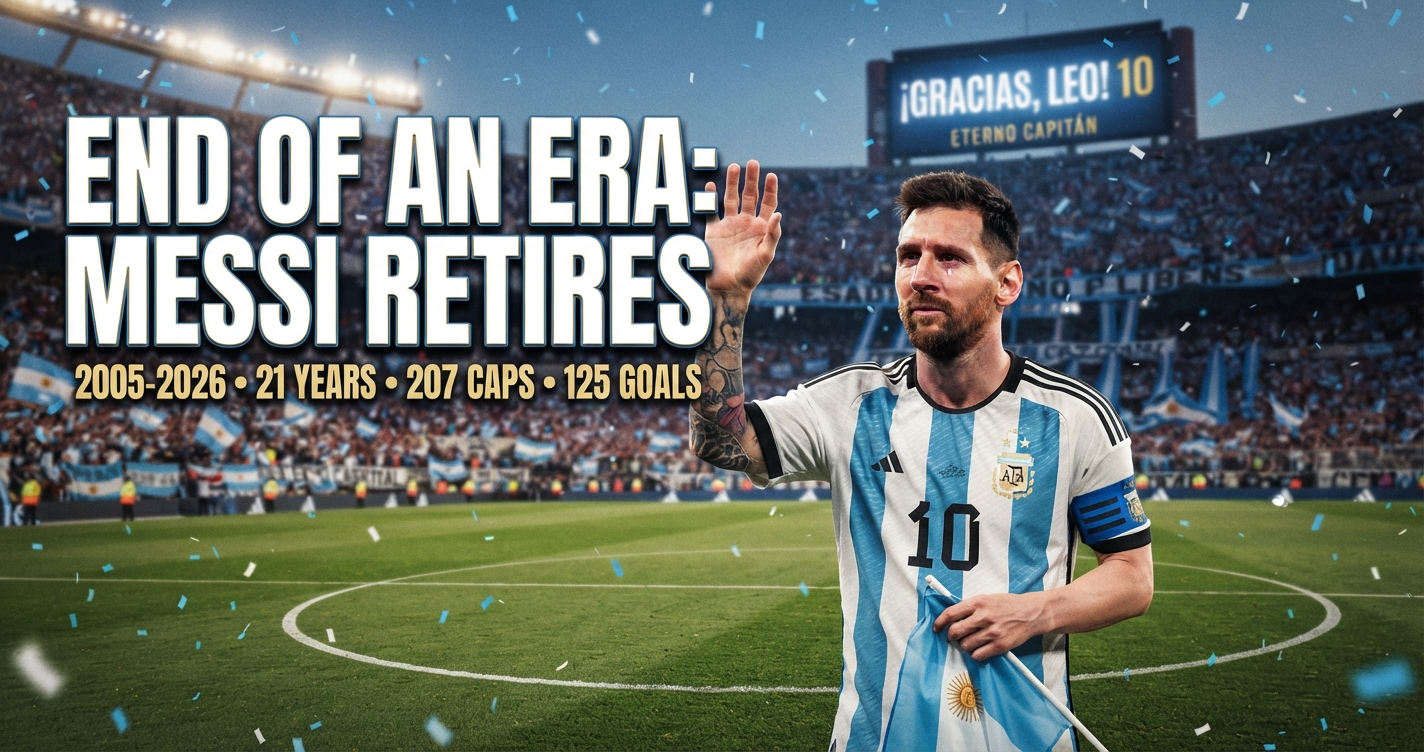
Lionel Messi, one of the greatest footballers in Argentina’s history, has announced his retirement from the Argentina national team, bringing an extraordinary international career spanning more than two decades to an end.
The 39-year-old forward, who has been the face of Argentine football for much of the past 20 years, decided to step away from international football after representing his country since making his senior debut in 2005.
Messi leaves the national team as Argentina’s most-capped player and its all-time leading scorer. He finished his international career with 207 appearances and 125 goals, figures that place him at the top of both major statistical categories in Argentine football history.
His decision marks the conclusion of one of the longest and most successful international careers ever produced by an Argentine footballer.
A 21-Year Journey with Argentina
Messi made his senior international debut for Argentina in 2005 as a teenager. From that moment, he gradually developed from one of the country’s most promising young talents into the central figure of a national team that would eventually achieve major international success.
Over the following 21 years, Messi became a permanent presence in Argentina’s biggest international tournaments, appearing in multiple editions of the FIFA World Cup and Copa América.
His journey with the national team was not always straightforward.
Despite his extraordinary individual performances, Messi experienced several difficult moments with Argentina early in his international career. Argentina suffered defeats in major finals, while Messi himself faced enormous expectations from supporters who compared his achievements with previous generations of Argentine football legends.
Those disappointments were followed by an extraordinary period of success.
From Disappointment to International Glory
Messi’s international career eventually reached a historic turning point when Argentina began winning major trophies.
The team captured the 2021 Copa América, giving Messi his first major senior international title with Argentina.
That success was followed by victory in the 2022 FIFA World Cup, when Argentina defeated France in one of the most memorable World Cup finals in history.
Messi played a decisive role throughout the tournament and was awarded the Golden Ball as the competition’s best player.
The World Cup triumph was particularly significant because it completed one of the few major achievements that had remained missing from Messi’s extraordinary career.
For years, the Argentine captain had been judged not only by his performances but also by whether he could lead his country to the biggest international trophy.
Winning the World Cup changed that narrative.
A Record-Breaking International Career
By the time he announced his retirement, Messi had established himself as Argentina’s record holder in both appearances and goals.
His 207 international appearances make him the most-capped player in Argentine history, while his 125 goals place him comfortably at the top of the national team’s scoring charts.
His goal-scoring record is particularly remarkable considering the level of competition faced by Argentina over his international career.
Messi scored against teams from different continents and across major tournaments, qualifiers and international friendlies.
His ability to create opportunities as well as score goals made him much more than a traditional striker.
Throughout his career, he frequently operated as a playmaker, dropping deep to receive the ball, creating chances for teammates and then arriving in dangerous positions to finish attacks himself.
The Captain of a Golden Generation
Messi also became the symbolic leader of one of the most successful generations in Argentine football.
As captain, he guided Argentina through a period that produced multiple major trophies and restored the national team to the top of world football.
His leadership became particularly important after Argentina’s earlier disappointments in major finals.
The team eventually developed a strong collective identity around Messi, with younger players growing alongside the veteran superstar.
The relationship between Messi and Argentina’s supporters also changed dramatically.
A player who had once faced intense criticism for failing to win a major senior international trophy eventually became a national hero after leading the team to continental and World Cup glory.
The End of an Era
Messi’s retirement represents more than the departure of a single player.
It marks the end of an era for Argentina’s national team.
For more than 20 years, Messi was at the center of Argentine football. Generations of supporters grew up watching him wear the famous blue-and-white shirt.
His presence became synonymous with Argentina’s biggest international matches.
From his first appearance as a young player in 2005 to his final years as the team’s captain and veteran leader, Messi remained one of the most important figures in international football.
His departure will leave a significant gap in the Argentina squad, both on the pitch and in terms of leadership.
A Legacy That Will Be Difficult to Match
Messi retires from international football with a record that may take many years to challenge.
He leaves behind 207 appearances, 125 goals and more than two decades of service to Argentina.
But his legacy cannot be measured only through statistics.
He became a player who influenced an entire generation of football supporters and inspired millions of young players around the world.
His combination of dribbling, passing, vision, finishing and creativity made him one of the most complete attacking players of his generation.
For Argentina, however, his greatest legacy may be the transformation of his relationship with the national team.
After years of disappointment, Messi ultimately became the leader who helped Argentina return to the summit of international football.
Messi’s Decision
Messi had reportedly been considering the possibility of ending his international career for some time.
The decision to retire came after the previous World Cup, when he began seriously considering how much longer he wanted to continue playing for Argentina.
At 39, Messi has reached a stage of his career where managing his physical condition and deciding how much football remains ahead of him have become increasingly important considerations.
Rather than continuing indefinitely, the Argentine star has now chosen to close the international chapter of his career.
His decision brings an emotional end to a remarkable journey that began more than two decades ago.
The End of Argentina’s Messi Era
Argentina will now have to prepare for life without the player who has been its most important footballing figure for more than two decades.
The national team will need to develop a new generation of leaders and attacking players capable of carrying the team forward.
For supporters, however, replacing Messi will be impossible in any simple sense.
There may be another great Argentine player in the future. There may even be another World Cup-winning generation.
But finding another player who combines Messi’s longevity, records, influence and connection with the national team will be an enormous challenge.
Messi leaves Argentina having written his name into virtually every major chapter of the country’s modern football history.
His 21-year international career, 207 appearances and 125 goals stand as a lasting record of his contribution.
For Argentine football, the Messi era is now coming to an end.
For the millions who watched him play for the national team, however, his legacy will remain long after his final appearance in the blue-and-white shirt.