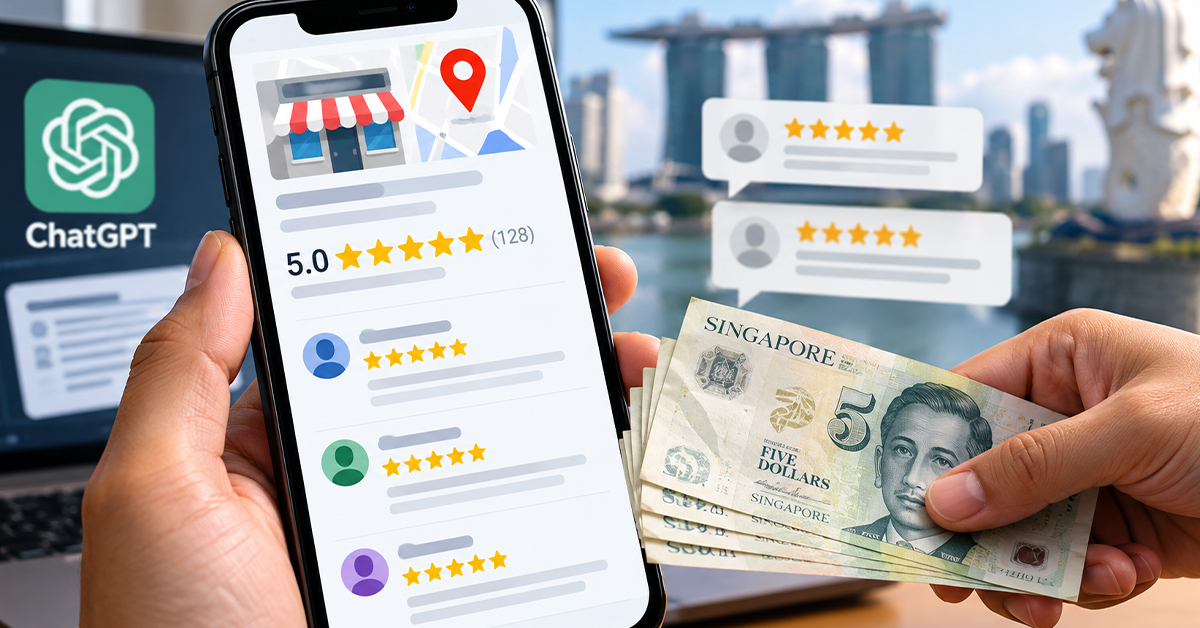

Some online five-star reviews may not come from customers at all. According to a Channel NewsAsia (CNA) investigation dated September 29, 2026, Singapore has an underground market where people are offered S$1 to S$5 to post positive business reviews.
The investigation describes a system connecting review brokers, online marketplaces and private messaging groups. It also raises concerns about how fabricated ratings can influence consumer decisions and whether platform moderation can detect coordinated manipulation.
Inside Singapore’s Paid Review Market
According to the supplied CNA research, recruitment often starts with listings on Carousell before moving to Telegram, where brokers share business links and prewritten testimonials.
The reported payment depends partly on the reviewer’s Google account history and Local Guide status.
| Reviewer category | Payment per review | Account requirements |
|---|---|---|
| Basic reviewer | S$1–S$2 | Standard account |
| Higher-tier reviewer | S$5 | Account at least one year old; Google Local Guide Level 5 or above |
During an undercover operation, a reporter was instructed to post prepared five-star testimonials on Google Maps. Seven test reviews were posted, then removed. The reporter received no commercial payment for them.
These findings demonstrate the operation of the investigated scheme, but they do not establish how widespread paid reviews are across Singapore.
How AI and Search Visibility Enter the Picture
Generative AI tools, including ChatGPT, can produce fluent promotional text. In the reported cases, AI-generated wording was part of the fake-review problem, including a 2025 case involving car detailing company Lambency Detailing.
The motivation may extend beyond improving a business’s average star rating. Industry expert Marcus Ho of Brew Interactive told CNA that businesses may also seek to influence search visibility and how their brands appear in AI-generated answers.
However, a convincing writing style does not prove that a review was created by AI, and the supplied research does not quantify how much fake reviews affect AI search results.
Singapore’s Enforcement and Platform Challenges
Singapore’s Consumer Protection (Fair Trading) Act addresses unfair trade practices, including fake reviews. The Competition and Consumer Commission of Singapore (CCCS) has taken action in documented cases.
Two examples reported in the research are:
-
Loft Home Furnishing: Formally censured by CCCS in 2024 for publishing fake five-star reviews.
-
Lambency Detailing: Admitted in 2025 to posting fake, ChatGPT-generated five-star reviews on Sgcarmart.
Carousell reportedly uses automated keyword filtering and user reports, while Google applies policies requiring reviews to reflect genuine experiences. Nevertheless, the CNA investigation found that suspicious recruitment listings and fake reviews could remain visible before removal.
The supplied research also notes that Google did not respond to CNA’s specific questions about its review-detection capabilities. The investigation therefore does not establish exactly how Google’s systems were bypassed.
How to Assess Online Reviews
A high rating alone cannot establish whether a business provides reliable service. Consumers can look for patterns that warrant closer examination:
-
Sudden clusters of five-star reviews, especially several posted within minutes.
-
Repetitive or generic praise with few details about a specific experience.
-
Repeated use of a business’s full name in review text.
-
Reviewer profiles with unusually sparse histories.
These are warning signs, not conclusive proof of manipulation. Compare reviews across different dates, read detailed positive and negative feedback, and look for specific experiences that are consistent across multiple customers.
What Readers Should Know
-
The investigation reported offers of S$1–S$5 per review, with higher payments tied to established Google accounts.
-
Coordinated reviews can distort the information consumers use to assess businesses and may be intended to influence online visibility.
-
The investigation does not establish the total size of Singapore’s fake-review market or the prevalence of fake reviews across all businesses.
Conclusion
Paid fake reviews exploit the trust consumers place in online ratings. Singapore’s enforcement cases show that businesses can face regulatory action, but moderation and enforcement do not guarantee that every deceptive review is caught before consumers see it.
For important decisions, treat star ratings as one source of information rather than proof of quality. Review patterns and detailed customer accounts can provide useful context, while remaining imperfect evidence.