Choosing a foldable smartphone is not just about getting the biggest screen. Weight, multitasking, camera flexibility and everyday convenience can make a bigger difference than processor specifications alone.
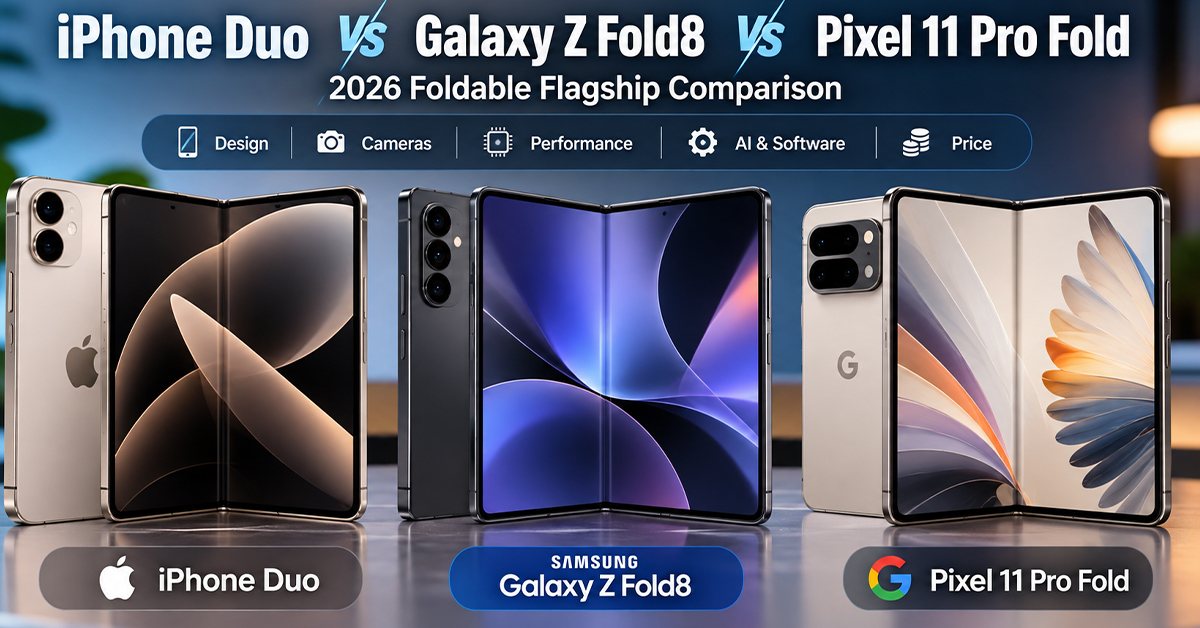
The iPhone Duo, Samsung Galaxy Z Fold8 and Google Pixel 11 Pro Fold illustrate three different approaches to fordable phones. Apple’s model emphasizes its titanium design and software ecosystem, Samsung focuses on portability and multitasking, while Google offers a larger inner display and a dedicated telephoto camera.
Here are the differences that matter when comparing these three devices.
iPhone Duo vs Galaxy Z Fold8 vs Pixel 11 Pro Fold: Specs Comparison
|
Specifications |
iPhone Duo |
Galaxy Z Fold8 |
Pixel 11 Pro Fold |
| Cover Display | 5.4 inches | 5.5 inches | 6.5 inches |
| Inner Display | 7.6 inches | 7.6 inches | 8 inches |
| Processor | A20 Pro | Snapdragon 8 Elite Gen 5 for Galaxy | Tensor G6 |
| Weight | 254 g | 201 g | 239 g |
| Main Camera | 48 MP | 50 MP | 48 MP |
| Ultrawide Camera | 48 MP | 50 MP | 10.5 MP |
| Telephoto Camera | Not listed | Not listed | 10.8 MP |
| Battery Capacity | 5,400 mAh | 4,800 mAh | 4,806 mAh |
| SIM Support | eSIM only | Physical SIM + eSIM | eSIM only |
| Operating System | iOS 27 | Android 17 / One UI 9 | Android 17 |
| Reported Price (Malaysia) | RM 9,499–15,499 | RM 7,099–8,899 | RM 8,599 |
1. A Bigger Screen Comes With Different Trade-Offs
The Pixel 11 Pro Fold has an 8-inch inner display, compared with 7.6 inches on both the iPhone Duo and Galaxy Z Fold8. That extra screen space could be useful for reading documents, viewing content and keeping multiple applications visible.
However, a larger display is not automatically more convenient. The phone’s weight and folded dimensions also affect how easily it can be carried and used throughout the day.
Samsung weighs 201 grams, making it the lightest of the three. Google’s device weighs 239 grams, while Apple’s iPhone Duo weighs 254 grams.
The difference between Samsung and Apple is 53 grams. Samsung is also reported to be thinner when folded, at 9.7mm compared with 11.3mm for the iPhone Duo.
For someone who prioritizes portability, these measurements are more directly relevant than a small difference in processor specifications.
2. SIM Support and Security Can Affect Everyday Use
One important difference is how the phones handle mobile connectivity.
The iPhone Duo and Pixel 11 Pro Fold are listed as eSIM-only devices, while the Galaxy Z Fold8 supports both a physical SIM and eSIM.
For travelers who regularly change mobile networks or use local SIM cards, Samsung’s physical SIM support offers an additional option. However, eSIM convenience depends on carrier compatibility and regional availability.
Biometric security also differs. Apple uses Touch ID rather than Face ID on the iPhone Duo, while Samsung and Google are listed with fingerprint and face-unlocking options.
These are practical differences that buyers should consider before choosing a device, particularly if they depend on a specific SIM arrangement or unlocking method.
3. Multitasking Is Where Samsung Stands Out
A fordable’s larger display becomes more useful when the software allows applications to work together.
Samsung’s One UI 9.0 includes an eight-slot persistent taskbar, App Pairs and three-way split-screen multitasking. App Pairs let users launch saved combinations of applications, while split-screen keeps multiple apps visible.
These features are particularly relevant to people who frequently switch between documents, messaging and other applications.
Apple’s iPhone Duo runs iOS 27 with Apple Intelligence and Siri AI. Its reported Apple Pencil support adds an option for document annotation and note-taking.
Google combines Android 17 with Gemini AI on the Pixel 11 Pro Fold.
The distinction is not simply which phone has more AI features. Buyers should consider which software ecosystem supports the applications and workflows they already use.
4. Camera Hardware and Battery Claims Need Context
The Pixel 11 Pro Fold has a triple rear-camera system, including a 48-megapixel main camera, a 10.5-megapixel ultrawide camera and a 10.8-megapixel telephoto camera.
The telephoto lens provides a dedicated zoom option that is not listed in the dual-camera systems of the iPhone Duo and Galaxy Z Fold8.
Apple uses two 48-megapixel rear cameras, while Samsung combines a 50-megapixel main camera with a 50-megapixel ultrawide camera.
These specifications explain the hardware differences, but they do not establish which phone produces better photographs. Image processing, low-light performance and actual camera testing are needed to make that assessment.
Battery capacity also requires context. Apple’s reported 5,400mAh battery is larger than Samsung’s 4,800mAh and Google’s 4,806mAh capacities. Yet capacity alone cannot establish which device lasts longest, especially when the phones use different displays and software.
5. Price and Long-Term Use Matter More Than Specs Alone
The supplied research lists Malaysian prices of MYR 9,499–15,499 for the iPhone Duo, MYR 7,099–8,899 for the Galaxy Z Fold8 and MYR 8,599 for the Pixel 11 Pro Fold.
These regional figures make the cost difference clear, but actual prices depend on storage configuration, retailer and market.
Samsung also has a reported 200,000-fold hinge rating. Apple’s hinge uses more than 100 components, but its long-term real-world durability cannot be established from that design description alone.
For buyers, the most useful comparison is between the features they will actually use, the cost of the chosen configuration and the device’s compatibility with their existing services.
The bottom line: Samsung’s lighter design and multitasking tools, Google’s larger display and telephoto camera, and Apple’s hardware and software ecosystem address different priorities. There is no single specification that settles the comparison for every user.