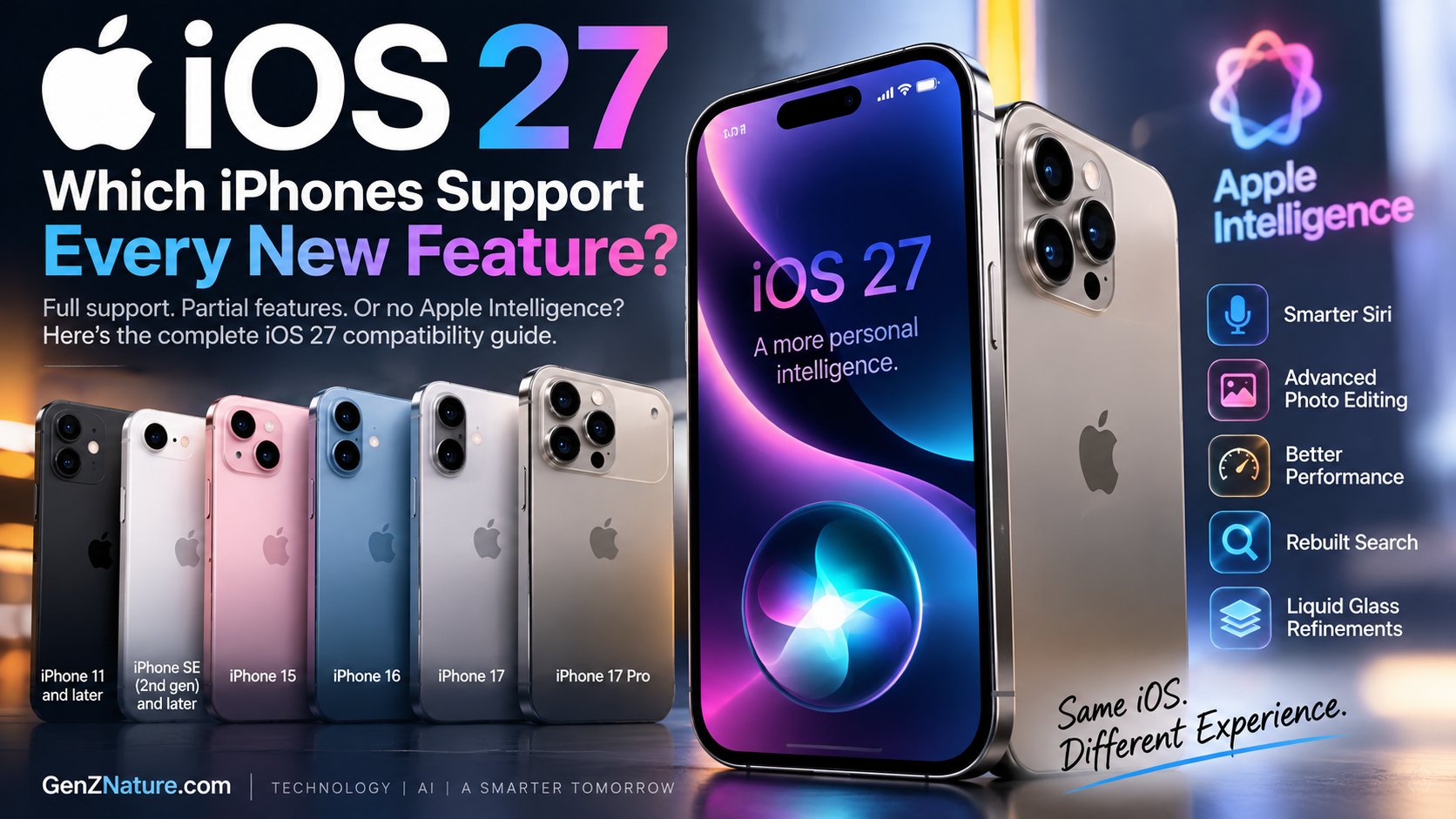
Apple’s iOS updates have traditionally been attractive because a large number of older iPhones can continue receiving the latest software. iOS 27 follows that pattern: the compatibility list reportedly remains the same as iOS 26, meaning Apple has not removed any iPhone models from software support this year.
But software compatibility and feature compatibility are no longer the same thing.
While iOS 27 can run on iPhones dating back to the iPhone 11, the most advanced Siri AI and Apple Intelligence capabilities require substantially newer hardware. As a result, iPhone users effectively fall into different feature tiers depending on the model they own.
A September 9, 2026 report by MacRumors, written by Tim Hardwick, outlines which iPhones are expected to receive the complete iOS 27 experience and which devices will receive only part of the new functionality.
What We Know So Far
According to the MacRumors report, iOS 27 supports:
- iPhone 11 and newer
- iPhone SE (2nd generation) and newer
That means owners of older compatible iPhones can still receive the operating-system update.
However, Apple’s newer AI-related features are limited by hardware capabilities. The result is a significant distinction between getting iOS 27 and getting all of iOS 27’s headline features.
The biggest dividing factor discussed in the report is memory.
The Three iPhones That Support Every iOS 27 Feature
At the top of the iOS 27 feature hierarchy are three models:
- iPhone 17 Pro
- iPhone 17 Pro Max
- iPhone Air
According to MacRumors, these are the only current iPhones capable of supporting the complete collection of new Siri AI features described in the report.
These models use Apple’s most advanced on-device Apple Intelligence model. That extra processing capability enables features including more accurate speech-to-text dictation and greater control over the way Siri speaks, including its expressiveness and speaking pace.
This distinction is important because it demonstrates how AI is changing smartphone hardware requirements.
In the past, a new iOS feature might primarily depend on the processor or graphics hardware. AI workloads can also place significant demands on a device’s memory, particularly when models need to operate directly on the phone rather than relying entirely on cloud processing.
Why Does RAM Matter?
RAM, or Random Access Memory, is the short-term working memory used by a device while applications and processes are running.
A phone with more RAM can keep more information available for active workloads without repeatedly moving data in and out of storage.
According to the MacRumors report, the advanced on-device model behind the exclusive Siri capabilities requires at least 12GB of RAM.
The iPhone 17 Pro, iPhone 17 Pro Max and iPhone Air reportedly meet that requirement.
By comparison, the iPhone 17 and iPhone 17e are listed as having 8GB of RAM, putting them below the threshold for those particular top-level features.
This is one reason why simply saying that an iPhone “supports iOS 27” doesn’t tell the whole story.
iPhone 16 and iPhone 15 Pro Still Get Major AI Features
The second tier includes the complete iPhone 16 family, including the iPhone 16e, as well as:
- iPhone 15 Pro
- iPhone 15 Pro Max
These devices support the standard Siri AI and Apple Intelligence features described in the report.
That includes a redesigned Siri interface and a standalone Siri app, along with capabilities intended to make interactions more natural.
The reported Siri improvements combine several types of information and interaction, including:
- Personal context
- Awareness of what is displayed on the screen
- Web-based knowledge
- More natural conversational interaction
- Actions performed inside apps
This is potentially more significant than a simple visual redesign.
The broader goal is to make Siri more useful in situations where the assistant needs to understand what the user is doing on the device and respond accordingly.
The same group of devices also receives new photo-editing capabilities mentioned in the report, including Extend and Spatial Reframing.
Older Compatible iPhones Get iOS 27 Without Apple Intelligence
The situation changes considerably for the iPhone 15, iPhone 15 Plus and older supported models.
These devices can receive iOS 27, but according to the MacRumors report, they will not receive Apple Intelligence or the new Siri capabilities.
That includes supported devices stretching down to the iPhone 11.
This creates an important distinction for people deciding whether to keep an older iPhone or upgrade.
An iPhone 11 owner may receive the same major operating-system update as someone using a much newer iPhone, but the actual feature set can be very different.
In other words:
iOS 27 compatibility does not automatically mean full iOS 27 feature compatibility.
That distinction is likely to become increasingly important as AI becomes a larger part of Apple’s software strategy.
What Older iPhones Still Gain From iOS 27
The absence of Apple Intelligence doesn’t mean older iPhones receive nothing useful.
MacRumors reports that iOS 27 also includes system-level improvements intended to benefit compatible iPhones more broadly.
One example is an upgraded CPU scheduler.
A CPU scheduler is part of an operating system that determines how computing tasks are allocated to the processor. Better scheduling can help the system manage workloads more efficiently.
iOS 27 is also reported to include:
- Rebuilt system search
- Refinements to Apple’s Liquid Glass design
- CPU scheduling improvements intended to help iPhones handle tasks more efficiently
These improvements matter because operating-system updates aren’t exclusively about headline AI features.
An older iPhone can still benefit from changes to the underlying software, even when it lacks the hardware necessary for Apple’s newest AI workloads.
The Hardware Divide Could Become More Important With iPhone 18
The RAM requirement described in the report may not be limited to the current generation.
MacRumors cites supply-chain analyst Ming-Chi Kuo for predictions about Apple’s future iPhone 18 lineup.
According to Kuo’s reported expectations, the standard iPhone 18 and iPhone 18e could have 9GB of RAM, while the iPhone 18 Pro, iPhone 18 Pro Max and the rumored foldable “iPhone Duo” could have 12GB.
These are analyst predictions, not confirmed specifications, so they should not be treated as final Apple product specifications.
If those predictions prove accurate, however, they would reinforce the same hardware segmentation seen with iOS 27: standard models could support Apple’s regular AI capabilities while higher-memory Pro models could gain access to more demanding on-device features.
Why It Matters
This could change how consumers evaluate iPhones.
Previously, an older iPhone receiving a new iOS version could make upgrading feel less urgent. But when major features depend on hardware resources such as RAM, two phones running the same version of iOS can offer noticeably different experiences.
For buyers, that means checking feature requirements, rather than looking only at the iOS compatibility list.
For existing iPhone owners, it also means that keeping a phone for several years may provide continued security and system updates while gradually excluding some of the newest AI capabilities.
EU Users Face a Separate Siri AI Limitation
There is also a regional complication.
According to the MacRumors report, Apple’s Siri AI will not be available on iPhone or iPad in the European Union at launch because of regulatory constraints associated with the bloc’s Digital Markets Act (DMA).
The report says the feature will be available in the EU through macOS 27 Golden Gate, while Apple continues working with EU regulators toward a solution for iPhone and iPad.
This means that hardware alone doesn’t necessarily determine whether a user can access a particular iOS 27 AI feature.
There can also be regional availability restrictions.
For consumers, that creates three separate questions:
- Is my iPhone compatible with iOS 27?
- Does my hardware support the feature I want?
- Is that feature available in my region?
All three can produce different answers.
iOS 27 Feature Tiers at a Glance
| iPhone group | iOS 27 | Apple Intelligence | Top-tier Siri AI |
|---|---|---|---|
| iPhone 17 Pro / Pro Max / iPhone Air | Yes | Yes | Yes |
| iPhone 16 lineup, including 16e | Yes | Yes | Standard AI features |
| iPhone 15 Pro / Pro Max | Yes | Yes | Standard AI features |
| iPhone 17 / 17e | Yes | Yes | Not all advanced features |
| iPhone 15 / 15 Plus and older supported models | Yes | No | No |
| iPhone 11 and newer | Yes | Depends on model | Depends on model |
The table illustrates the key point: Apple is maintaining broad operating-system support while differentiating advanced AI capabilities according to hardware.
What This Means for iPhone Owners
The most important takeaway from the iOS 27 rollout is that an iOS version number alone is becoming a less useful way to judge whether a phone is “supported.”
For someone using an older compatible iPhone, installing iOS 27 can still bring system improvements and interface changes.
But users interested specifically in Apple’s latest AI-powered features need to pay attention to the individual hardware requirements.
The iPhone 17 Pro, iPhone 17 Pro Max and iPhone Air sit at the top of the feature hierarchy described by MacRumors, while the iPhone 16 family and iPhone 15 Pro models remain capable of running Apple’s standard Apple Intelligence features.
Meanwhile, iPhone 15 and older supported devices can continue receiving iOS 27 without access to Apple’s newer AI and Siri functionality.
That may become an increasingly common pattern as smartphone operating systems incorporate larger and more capable AI models.
Bottom Line
iOS 27 is broadly compatible, but its feature set is not.
Apple’s approach allows older iPhones to continue receiving the latest operating system while reserving some of the most demanding AI functionality for devices with sufficient hardware resources.
For users deciding whether to upgrade, the practical lesson is simple: don’t ask only whether your iPhone gets iOS 27. Check which specific features your model can actually run.
Disclaimer / What to Know
This article is based only on the information provided from a September 9, 2026 MacRumors report by Tim Hardwick.
References to the iPhone 18 lineup, RAM configurations and the rumored foldable “iPhone Duo” are based on Ming-Chi Kuo’s reported supply-chain predictions cited by MacRumors, not confirmed Apple specifications. They should therefore be treated as forecasts rather than finalized product information.
Feature availability can also vary by region, particularly in the European Union, where the MacRumors report identifies regulatory restrictions affecting Siri AI at launch.