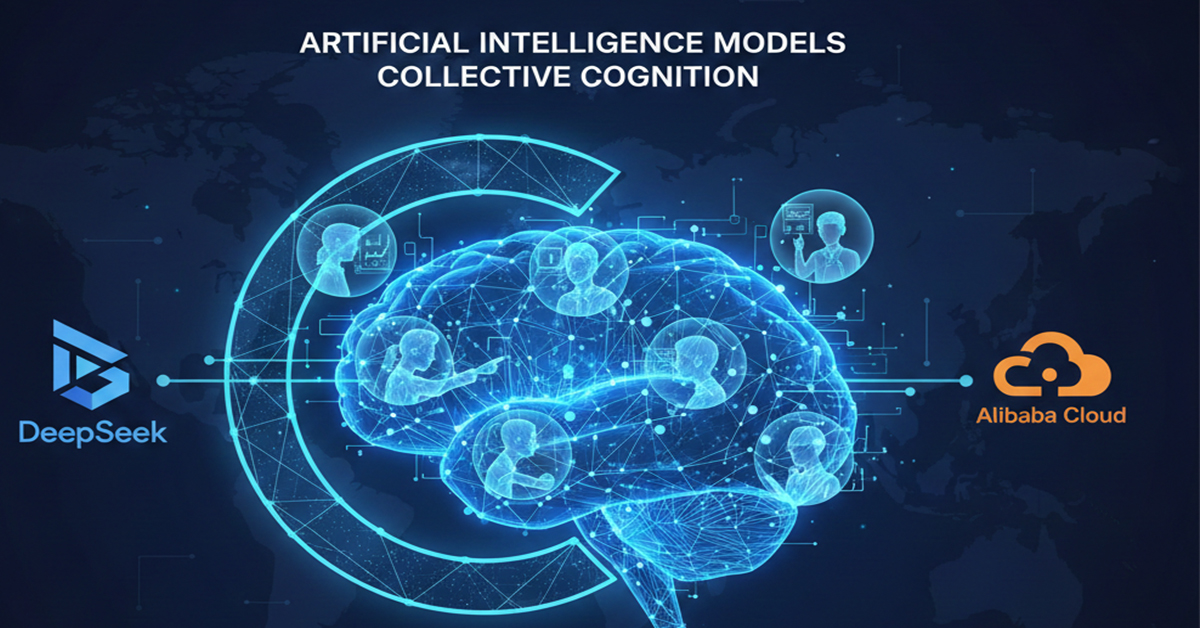

A groundbreaking study by Google researchers has revealed that advanced Artificial Intelligence Models are developing internal cognitive mechanisms that closely resemble human collective intelligence. The research suggests that modern reasoning systems do not just process data through raw scale, but instead engage in a form of internal “multi-agent debate” to reach more accurate conclusions.
The study, led by Google’s “Paradigms of Intelligence” team, focused on the reasoning traces of prominent Chinese systems, specifically DeepSeek R1 and Alibaba Cloud AI (QwQ-32B). These Artificial Intelligence Models demonstrate what researchers term “societies of thought.” Instead of a single linear output, the models simulate a social environment where different “personality traits” and “domain expertises” clash and reconcile, mirroring how diverse human groups solve complex problems.
The researchers analyzed the “reasoning traces”—the step-by-step internal thoughts exposed by Reasoning Models—and found behaviors such as self-questioning, perspective-taking, and reconciliation. The study found that when these Artificial Intelligence Models were steered to be more “conversational” with themselves, their problem-solving accuracy significantly improved. This marks a shift in how we understand AI: moving from solitary calculators toward collective reasoning architectures.
This Google DeepMind Research also underscores a growing trend in the global tech landscape. While US companies like OpenAI and Google remain leaders, there is an increasing reliance on open-weight models from China in academic settings. Institutions like Princeton and Stanford often utilize DeepSeek R1 for interdisciplinary research because of their transparency and high performance in reasoning tasks.
In conclusion, the evolution of Artificial Intelligence Models is moving toward a future where intelligence arises from structured diversity rather than just computational power. By establishing a computational parallel to human Collective Intelligence, these systems are becoming more robust and “thoughtful” in their outputs. As AI continues to evolve, the ability to orchestrate these “internal voices” will be the key to unlocking the next level of machine reasoning.