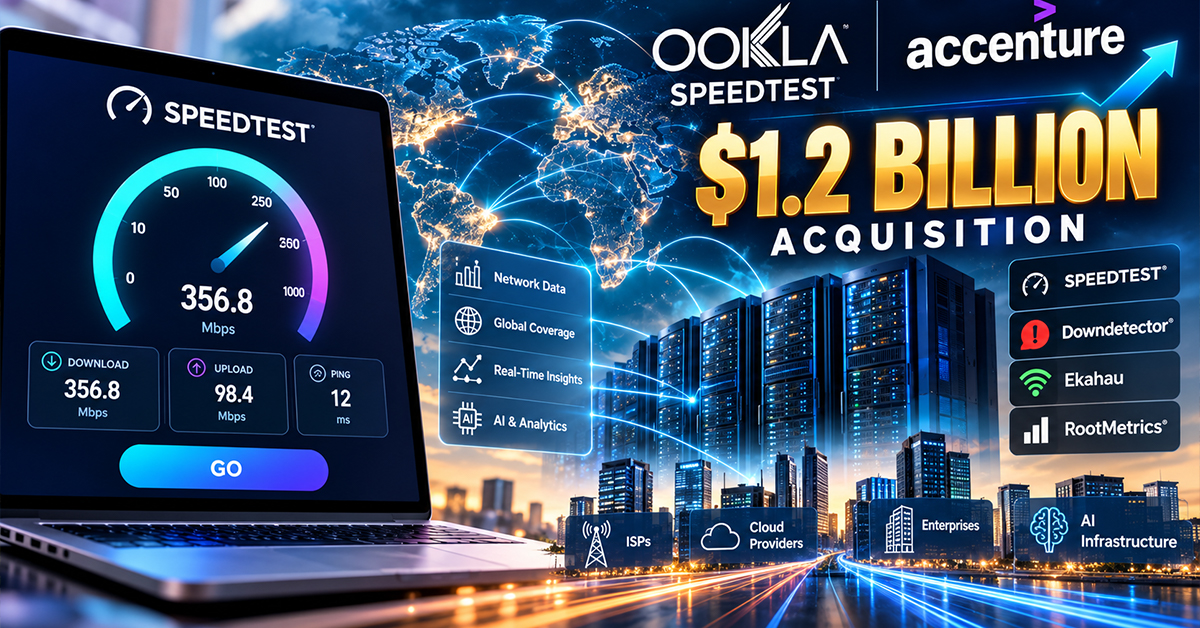
An internet speed test appears deceptively simple. A user clicks a button, data moves between a device and a server, and the service reports download speed, upload speed and latency.
Yet the business behind one of the world’s best-known speed-testing platforms became part of a $1.2 billion acquisition. The reason is not the basic speed-test code itself. It is the network intelligence, data and commercial infrastructure built around millions of measurements.
The Code Is Not the Main Asset
The fundamental mechanics of a speed test are straightforward. Download speed is calculated from the amount of data transferred to a device over time, while upload speed measures data sent in the opposite direction. Ping or latency measures the round-trip time between the device and a server.
The 36Kr analysis notes that basic speed-test implementations can be extremely small, with some examples around 9KB. It also cites Speedcheck founder Forcer saying that he built the core testing code over a weekend.
That makes an important distinction: building a speed-test function is relatively accessible; building a global network intelligence business is not.
Where the Business Value Comes From
Accenture announced its agreement to acquire Ziff Davis’s Connectivity division for $1.2 billion in March 2026. The transaction included Ookla and its Speedtest, Downdetector, Ekahau and RootMetrics products. It officially closed on June 17, 2026.
Accenture says Ookla’s platform captures more than 1,000 attributes per test and is supported by more than 250 million consumer-initiated tests each month. These measurements provide information about network performance, devices, locations and connectivity conditions.
| Business layer | What creates value |
|---|---|
| Speed-test software | Measures download, upload and latency |
| User activity | Generates large volumes of real-world measurements |
| Network intelligence | Turns measurements into connectivity insights |
| Enterprise products | Supports network planning, benchmarking and troubleshooting |
| Commercial model | Subscription and licensing-based revenue alongside other products |
The scale matters because network conditions change. A connection that performs well today may behave differently after infrastructure changes, congestion or configuration updates.
Why Enterprises Care About the Data
For a business operating hundreds or thousands of locations, knowing the advertised internet package is not necessarily enough. Actual performance can vary by location, network operator, device and time.
A large measurement database can therefore help organizations understand real-world connectivity and make better infrastructure decisions.
Accenture specifically positions the acquisition around communications service providers, cloud and hyperscale companies, and enterprises. It says the combined capabilities can support network optimization, AI infrastructure, edge data centers and private 5G or Wi-Fi environments.
This is where the business model becomes substantially different from a small website supported by advertising.
Advertising Is One Model; Data Infrastructure Is Another
A developer can publish a browser-based speed-test tool and attempt to attract search traffic. Coding Shiksha has promoted a speed-test script and cited a potential $5-per-day advertising opportunity.
However, that figure is not an independently verified revenue benchmark. It depends on achieving particular search rankings, attracting sufficient traffic and generating advertising revenue, so it should not be interpreted as a guaranteed return.
At enterprise scale, the economics are based on a much larger asset. Accenture said Ookla generated $231 million in calendar-year 2025 revenue, using non-FTE subscription and licensing revenue models.
The contrast explains why a small speed-test script can be inexpensive while a mature network-intelligence business can command a billion-dollar acquisition price.
What Readers Should Know
- The $1.2 billion transaction covered a broader Connectivity division, not simply the Speedtest application or its underlying code.
- The valuable asset is the measurement ecosystem: large-scale connectivity data, network intelligence, products and enterprise relationships built around it.
- Small website advertising and enterprise data businesses are fundamentally different models, and the advertised $5/day figure should not be treated as guaranteed income.
Conclusion
The internet speed-test market demonstrates that software value is not determined by code size alone. A basic speed-test function can be reproduced relatively cheaply, but collecting measurements at global scale and turning them into useful network intelligence requires users, infrastructure, data and commercial products.
That difference is what turns a simple “speed check” into a much larger technology business.
Sources and Further Reading
Source links used
- Accenture — Ookla acquisition announcement — acquisition scope, closing date, 1,000+ attributes and 250M+ monthly consumer-initiated tests. Accenture Newsroom
- Ziff Davis — Connectivity Division transaction filing — confirms the $1.2B cash transaction and the brands included. SEC
- Accenture — Q2 FY2026 earnings materials — supports the $231M 2025 revenue and subscription/licensing revenue model. investor.accenture.com
- 36Kr — Speedtest business-model analysis — supports the 9KB example, speed-test mechanics, 10M+ daily users and 15,000+ server figures. 36Kr
- Coding Shiksha speed-test script source — source for the promotional $5/day advertising claim.